Sassafras, Mitten Tree
Botanical Family : Lauraceae
Native to : Eastern United States
Researched by : Ann Wilson
Botanical Family:
Lauraceae
The Laurel Family, contains true laurels and many species of typically aromatic evergreen trees or shrubs, like Bay Laurel and Camphor Tree, a group of parasitic vines, and yet also contains popular food species like Avocado and Cinnamomum.
Cultivation:
Growth Habit : Deciduous tree, growing from 20-60 ft tall, may be more shrub like in northern regions.
Bark : Grayish with reddish brown furrows on mature trees.
Wood : Aromatic, brittle, coarse grained, orangish colored.
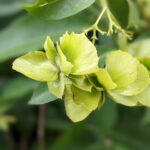
Leaves : Aromatic, smooth, green, 4-5 inches long and 2-4 inches wide, three different forms may be found on the same tree – oval, two lobed and three lobed. Leaves turn reddish orange in the fall.
Blooms : Racemes of small, petal-less, fragrant flowers with yellow green half-inch sepals appear before leaves. Trees are dioecious with male and female flowers appearing on separate plants.
Seeds : Half-inch long, oval, dark blue drupes on female trees.
Roots : Aromatic, lateral spreading, shallow roots that sucker readily.
Grow in well-draining, rich, neutral to acidic soil in sun or shade. In Texas it does well as an understory tree. Although transplanting may be difficult, trees can be propagated from suckers, by root cuttings or from fruits harvested in the fall. Germination of seed is reported to be slow. Refer to The Herb Society of America’s Notable Native handout on Sassafras albidum for detailed instructions.
Sassafras may be susceptible to damage from Japanese Beetles.
Folklore & Traditional Uses:
From medicine to flavorings to beverages to dyes to landscaping, Sassafras albidum has a long history of use in North America and a short but widespread use as a medicinal in Europe. Native Americans were reported to have used it to treat fevers, rheumatism, skin diseases and wounds, as a postpartum tonic and as flavoring. Native peoples in Florida introduced it to Spanish explorers and colonists in the early 16th century. Individuals returning to Spain from “The New World” reported on its use to physician and botanist Nicolás Monardes who began to promote it as a remedy for fevers due to malaria and as a “cure-all”. Sassafras was one of the first North American plants to be exported from the colonies back to Europe and in the late 16th and early 17th centuries it became popular in Europe as a cure for syphilis, a spring tonic and “cure-all”. Sassafras root tea was called “saloop” and widely sold in the street booths of London. Then the market for it crashed as people realize it really wasn’t a wonder tonic that solved all ills.
In North America, physicians continued to use sassafras tea to treat an assortment of issues including fever, bladder complaints, respiratory diseases, indigestion and menstrual concerns but its most popular use became as a spring tonic, a pleasant beverage and as a flavoring for medicines, tobacco, root beer, tooth paste, gum, jelly, and to scent soaps, perfumes and potpourri. At one time it was even used in the manufacture of postage stamps. The aromatic wood was also believed to be a moth and lice repellent.
In 1685 William Penn wrote of beer and rum punch flavored with sassafras and Sacred and Herbal Healing Beers by Stephen Buhner includes two recipes for beer, one from 1846 and the other from 1925. Sassafras was also one of the original flavorings in the unique tasting “State Soda of Maine”, Moxie, which was originally marketed as Moxie Nerve Food and contained sassafras along with gentian, wintergreen, and other herbs. Sassafras flavoring was removed from it following the 1960 FDA ban on safrole.
In Louisiana, Native Americans used the ground leaves of the sassafras tree as a flavoring and thickener
in soups and Cajuns adopted the use of this filé, (from the French word for spun, perhaps referring to
the thready appearance when added to liquid) for their enduringly popular gumbo.
Modern & Medicinal Uses:
Of course, filé is still widely used today and products containing sassafras with safrole removed may be found. The root bark can still be used as a natural dye today as it was in colonial times. When combined with various mordants it may yield orangish, tan, rose brown, or grey colors. The best use of Sassafras albidum today may be as a landscaping plant where its orange and red foliage brighten the autumn garden and its leaves provide food for Palamedes, Tiger, and Spicebush Swallowtail butterflies.
Toxicity
In 1960, the Federal Drug Administration banned sassafras oil as a flavoring due to the potential of
safrole, the major component of the oil, to cause liver cancer. In 1976, Sassafras bark for tea was also
banned. The leaves do not contain safrole and so are safe to consume as filé. There are also products
used as sassafras flavorings that have had the safrole removed and are considered safe for
consumption. The banning of sassafras tea was considered controversial by many people, however,
newer research also indicates the possibility of DNA alterations caused by consumption of safrole. The
review article by Lunz found in the references section has many interesting, although often technical,
references concerning possible actions of safrole.
Essential Oil : 80-90% safrole
Root and Root Bark : 60-80% safrole, 2-18% camphor, 2-5% methyl eugenol
Leaves : 30% (Z)-nerolidol, 22% beta-caryophyllene, 20% linalool, 0-trace amounts safrole
References:
Ajilvsgi, Geyata, 1990, Butterfly Gardening for the South, Taylor Publishing Company. Dallas, Texas.
Adrosko, Rita J. 1971, Natural Dyes and Home Dyeing. Dover Publications, Inc. New York.
Bender, Steve, 1998, The Southern Living Garden Book, Oxmoor House. Birmingham, Alabama.
Bown, Deni, 2001. The Herb Society of America New Encyclopedia of Herbs and Their Uses, Dorling Kindersley. London.
Buhner, Stephen Harrod, 1998, Sacred and Herbal Healing Beers, Brewers Publications. Boulder,
Colorado.
Foster, Steven, 1993, Herbal Renaissance, Gibbs-Smith Publishers. Salt Lake City.
Foster, Steven, 2017, “Exploring Medicinal Trees in American Forests”, Herbalgram Issue 116 (Winter
2017) American Botanical Council.
Foster, Steven & James A. Duke, 2000, Eastern/Central Medicinal Plants & Herbs, Peterson Field Guide
Series, Houghton Mifflin. New York.
The Herb Society of America’s Notable Natives™ Herbal Tree 2025 “Sassafras albidum Fact Sheet”
https://www.herbsociety.org/explore/notable-native-herbsprofiles.html (Accessed 9/16/2025).
Lewis, Walter H and Memory P.F. Elvin-Lewis, 2003, Medical Botany. John Wiley & Sons, Inc. Hoboken,
New Jersey.
Lunz K, Stappen, I, “Back to the Roots-An Overview of the Chemical Composition and Bioactivity of Selected Root-Essential Oils. Molecules.” 2021 May 25;26(11):3155. doi: 10.3390/molecules26113155.
PMID: 34070487; PMCID: PMC8197530. https://pmc.ncbi.nlm.nih.gov/articles/PMC8197530/
(Accessed 9/16/2025).
Missouri Botanical Garden Website, https://www.missouribotanicalgarden.org/PlantFinder/PlantFinderDetails.aspx?kempercode=i820
(accessed 9/16/2025).
Naegele, Thomas A. 1996, Edible and Medicinal Plants of the Great Lakes Region, Wilderness
Adventure Books. Davisburg, Michigan.
Sumner, Judith, 2000, The Natural History of Medicinal Plants, Timber Press. Portland, Oregon.
Tucker, Arthur O. and Thomas DeBaggio, 2000. The Big Book of Herbs, Interweave Press. Loveland,
Colorado.
Tull, Delena, 1987, “A Practical Guide to Edible & Useful Plants”, Texas Monthly Press. Austin, Texas.
Turner, Matt Warnock, 2009, Remarkable Plants of Texas, University of Texas Press. Austin, Texas.
Tyler, Varro E. 1993, “The Honest Herbal: A Sensible Guide to the Use of Herbs and Related Remedies”, 3rd
Ed. Pharmaceutical Products Press, an imprint of The Haworth Press. Binghamton, New York.
University of Massachusetts Lowell Library Website. The Story of Moxie.
https://libguides.uml.edu/c.php?g=525571&p=9539418 (Accessed 9/29/2025).
Return to North America
Return to Pharmacy Garden
It is the policy of The Herb Society of America, Inc. not to advise or recommend herbs for medicinal or health use.
This information is intended for educational purposes only and should not be considered as a recommendation or an endorsement of any particular medical or health treatment. Please consult a health care provider before pursuing any herbal treatments.