Butcher’s Broom, Sweet Broom, Knee Holly
Botanical Family : Asparagaceae
Native to : Mediterranean, North Africa, Middle East
Researched by : Julia Johnson
Botanical Family:
Asparagaceae, the Asparagus Family
A large family that spans somewhere between 2,500 – 3,000 species!
The Asparagus Family contains a wide variety of familiar plants like yucca, hosta, spider plant, corn cane, mother-in-law’s tongue, not to mention the namesake- asparagus.
These plants often have thickened rhizomes, tubers, or corms, and may produce berries or capsules. They typically have a basal rosette growth style and parallel venation of the leaves. Plants of the asparagus family are found on every continent besides Antarctica and range in habitats from blazing deserts, moist shady forests, mediterranean climates, or arid scrublands.
Cultivation:
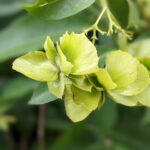
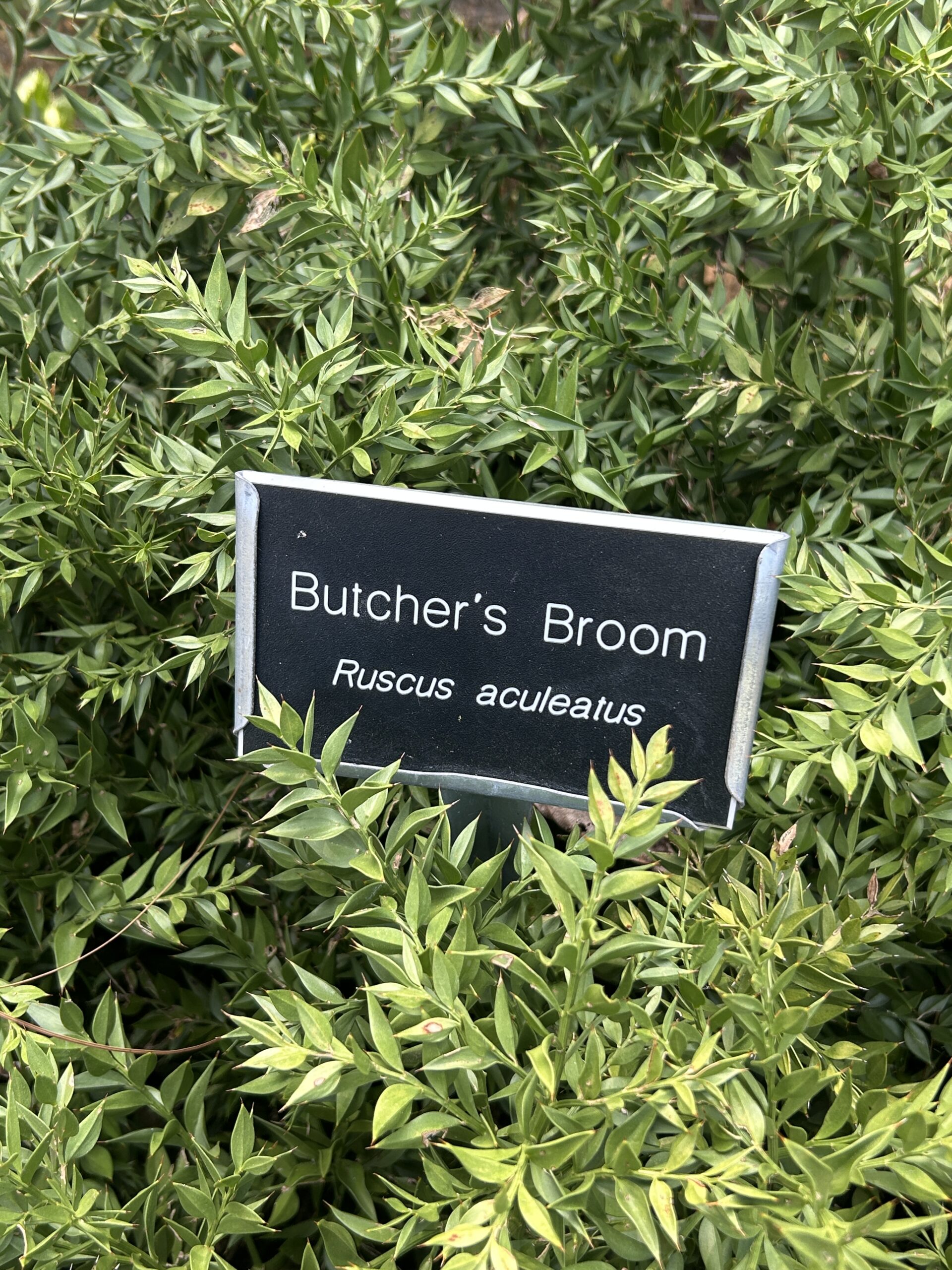
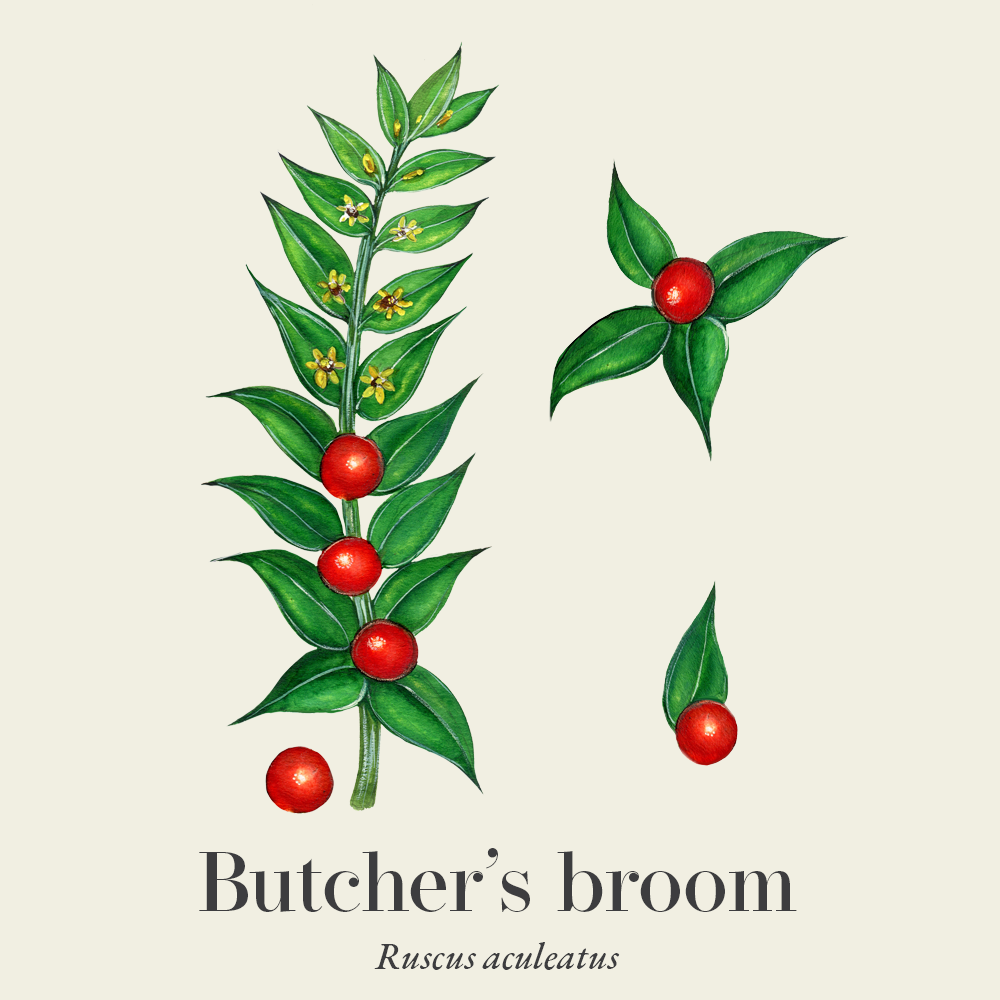
Butcher’s Broom is a bushy evergreen shrub, growing 2-3 feet in height and spread, that reproduces by creeping rhizomes or seed. Short branches have glossy, lance-shaped “leaves” which are actually cladodes (flattened modified branches or stems), each terminating with a single, sharp spine. Tiny pale, yellow-green solitary flowers emerge in spring. By autumn, glossy, red, pea-sized berries develop on female plants, appearing to sit atop the “leaves”. This plant is dioecious, meaning there is a male and a female plant. It was recommended to plant 1 male : 6 female plants to maximize berry production. (I have not seen our Butcher’s Broom bloom or berry, so we may need to find it a mate.)
This hardy perennial thrives in most soil conditions. It is popular as an ornamental species due to its unusual flowers and bright red berries. Cut out any dead stems in the spring. Propagate by rhizome division in autumn. It is known for tolerating dense shade, yet performs great in our Texas full sun. Tolerates salt, drought, and heat.
No known/observed insect or disease problems.
Folklore & Traditional Uses:
Ancient physicians like Dioscorides in the first century recommended Butcher’s Broom as an aperient (laxative), appetite stimulant, and as a diuretic for dropsy, urinary obstructions, and nephritic (kidney) ailments.
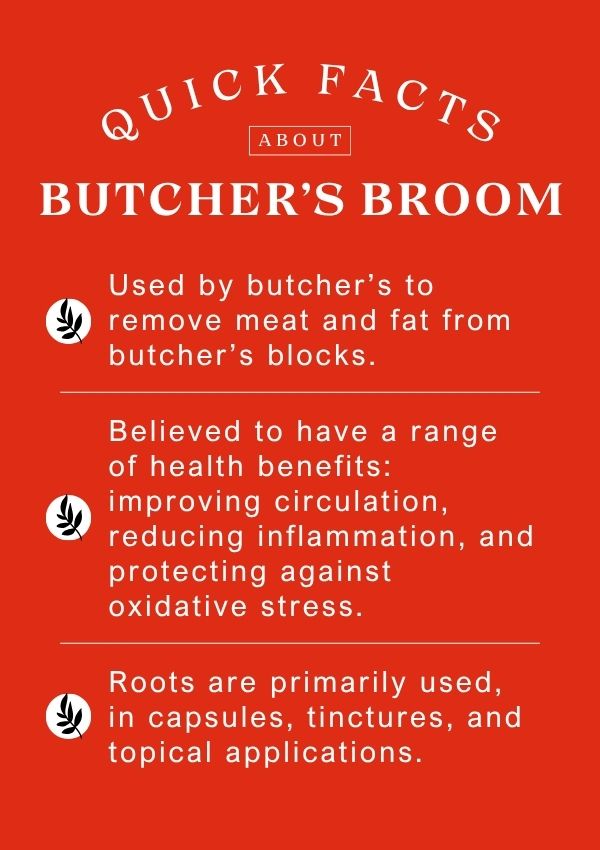
The common name, Butcher’s Broom, originated in Europe where butchers historically made tightly bundled branches into a broom which was ideal for scraping off meat and fat residue from butcher’s blocks. Additionally, it is also antimicrobial.
In 1693, Culpepper referred to this plant as “being of gallant, cleansing and opening quality”. During this time a concoction of the root in wine was used to open obstructions, increase urine, expel gravel and stones, clear jaundice and the associated headaches, and clear the chest of phlegm and “clammy humors within”. Culpepper also referred to poultices of the root being used to knit together broken bones or parts out of joint.
By the 1800s American Pharmacopoeias referred to Butcher’s Broom as an excellent medicine for removing obstructions, with the power of urine, removal of gravel of the kidney or gallbladder, for jaundice, and for helping regulate menstrual cycles.
Studies in the 1950s of the steroidal saponin content of the plant, due to its triterpenoid ruscogenin, resulted in the use of Butcher’s Broom as a venous tonic for venous insufficiency.
Modern & Medicinal Uses:
Chemical Components:
- Steroidal saponins (0.5-1.5%): Deglucoruscin, ruscin, esculin
- Saponin aglycone: Rusogenin, neoruscogenin
- Saponin glycosides: Ruscine, ruscoside, aculeosides A and B
- Flavonoids: Rutin
- Sterols: Sitosterol, campersterol, stigmasterol
- Coumarins: Esculin and esculetin, sparteine, tyramine and glycolic acid
Saponins are bitter-tasting metabolites that become foamy in water when agitated, present in many plant species, commonly used in soaps, medicines, fire extinguishers, steroid synthesis, and even carbonated beverages. These saponins provide anti-inflammatory and diuretic properties that serve to strengthen blood vessels and improve circulation.
Flavonoids help protect plants from UV damage, environmental stress, pathogens, and regulates cell growth. The flavonoids in Butcher’s Broom, hesperidin and rutin, reduce inflammation and protect against oxidative stress.
Butcher’s Broom also has a rich source of vitamins and nutrients. It contains Vitamin C, Calcium, Folic Acid, and Iron- all of which help maintain strong bones, red blood cells, and overall health.
Caution:
Mild gastrointestinal upset may occur, it is recommended to always consume Butcher’s Broom products with an appropriate amount of water and food. Due to its activity in the body, it can interfere with medications like blood thinners. It is generally considered safe, but always consult your healthcare providers when implementing any new medications or herbal preparations.
Recipes:
Believe it or not, but this bristly and rough textured plant has often been used in culinary preparations. The fresh young shoots of Butcher’s Broom can be cooked and eaten like Asparagus. Additional online claims stated that berries have been used for jams, and alcoholic beverages have been flavored with Butcher’s Broom, but these claims I could not confirm.
Vein-Soothing Lotion
From Herbal Reality, https://www.herbalreality.com/herb/butchers-broom
Ingredients
20 ml peppermint or rosemary essential oil
250 g aloe vera gel or plain base cream
10 ml butchers broom root infused oil
10 ml calendula oil
10 ml butchers broom root tincture
10 ml horse chestnut seed tincture
10 ml yarrow tincture
10 ml witch hazel distilled water
Method
- Place the aloe vera or base cream in a bowl and gradually whisk in the oils, one teaspoon at a time.
- Use the same method to gradually add the tincture, whisking thoroughly.
- Add the essential oil, then the witch hazel water
- Apply twice per day to varicose veins, thread veins or haemorrhoids.
Traditional European Preparations
Decoction
Harvest rhizomes in autumn or winter, wash thoroughly, slice and dry. Then simmer in water for 15-30 minutes.
This was historically used for swollen legs, hemorrhoids, poor circulation, and water retention.
Alcohol Tincture
Use dried rhizome. Cover with alcohol. Allow to infuse for 3-4 weeks. Strain and bottle.
This allows for a long shelf-life and concentrates the medicinal components.
Infused Oils and Salves
Use dried rhizome, powered. Allow to infuse into oil for 3-4 weeks in a dark location. Shake often.
If desired to make into a salve, warm oil then combine with beeswax to desired texture.
Butcher’s Broom is often combined with other herbs like Calendula officinalis, Hamamelis virginiana (American Witch Hazel), and Aesculus hippocastanum (Horse Chestnut) for use with varicose veins, bruising, or hemorrhoids.
Many European herbal creams often combine with Centella asiatica (Gotu Kola), common grapevine, and Aesculus hippocastanum (Horse Chestnut) for creams that help with circulation support intended for leg heaviness.
References:
Lambeth-Mansell, Anneliese, Butcher’s Broom, HerbalReality.com, https://www.herbalreality.com/herb/butchers-broom/, Accessed on 5/30/2026.
Multiple Authors, Asparagaceae, Wikipedia.com, https://en.wikipedia.org/wiki/Asparagaceae, Accessed on 5/30/2026.
Multiple Authors, Ruscus aculeatus, Wikipedia.com, https://en.wikipedia.org/wiki/Ruscus_aculeatus, Accessed on 5/30/2026.
Raman, Ryan, Butcher’s Broom: A Shrub with Surprising Benefits?, healthline.com, https://www.healthline.com/nutrition/butchers-broom, Accessed on 5/30/2026.
Ruscus aculeatus, Missouri Botanical Garden, https://www.missouribotanicalgarden.org/PlantFinder/PlantFinderDetails.aspx?taxonid=281908, Accessed on 5/30/2026.
Hobbs, Christopher, Ph.D. Butcher’s Broom, https://christopherhobbs.com/herbal-therapeutics-database/herb/butchers-broom/, Accessed on 5/30/2026.
Johnston, Paul, Butcher’s Broom: Surprising Benefits for Blood Vessels, The Herb Prof, https://theherbprof.com/butchers-broom/, Accessed on 5/30/2026.
Return to Mediterranean
Return to Pharmacy Garden
It is the policy of The Herb Society of America, Inc. not to advise or recommend herbs for medicinal or health use.
This information is intended for educational purposes only and should not be considered as a recommendation or an endorsement of any particular medical or health treatment. Please consult a health care provider before pursuing any herbal treatments.