Amaryllis
Botanical Family : Amaryllidaceae
Native to : South America
Researched by : Wendy Matthews
Botanical Family:
Amaryllidaceae
This family of monocots is found worldwide in temperate and tropical regions. Most species grow from underground bulbs. Alliums and narcissus are also in this family.
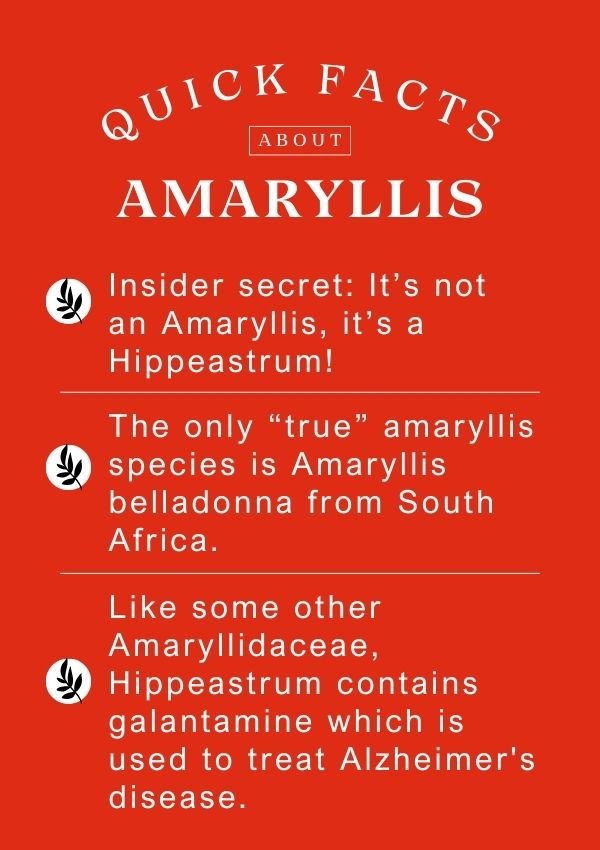
“Amaryllis” vs “Hippeastrum” Don’t know about you, but I’ve always found this confusing. As it turns out, botanists were also confused for over 200 years! It’s unclear whether the plant Linnaeus cataloged as “Amaryllis” was a true Amaryllis from South Africa or a Hippeastrum from South America. The botanists argued about it until finally in 1987 the International Botanical Congress decided that the flower being sold as Amaryllis all over the country was actually Hippeastrum. The true Amaryllis is Amaryllis belladonna, also known as the Jersey lily or belladonna lily. But the name Amaryllis is still (incorrectly) used for Hippeastrum.
Cultivation:
Hippeastrum is native to tropical and subtropical regions, primarily in two areas: eastern Brazil and the central-southern Andes (including Peru, Bolivia, and Argentina). The genus is believed to have originated in Brazil, where at least 34 species have been identified. Some species occur as far north as Mexico and the West Indies. There are approximately 90 species within the genus and over 600 commercial hybrids. Most Hippeastrum hybrids are derived from the following species: H. vittatum, H. leopoldii, H. pardinum, H. reginae, H. puniceum, and H. aulicum.
Morphology :
Hippeastrum bulbs produce a hollow flower stalk, often before the leaves are produced. Two to seven medium green leaves grow up to 2 feet long. Large bulbs may produce more than one flower stalk. Each 18-24” tall stalk produces two to six large flowers 6 to 10 inches long. Fertilized flowers are followed by fruits that are a trivalve capsule filled with dry, flattened brown or black seeds. Most flowers are in the red and white range but there are some in yellow or pale green colors. Hippeastrum hybrids are usually unscented.
Growing :
Hippeastrum cultivars and species can be grown inside in pots or outside in warmer climates (USDA zones 8-11). The bulb should not be exposed to frost. In its native habitat, the leaves die back to the ground in the fall and the plant remains dormant until spring.
Indoors :
Amaryllis bulbs should be planted in a container about 1 inch larger than the diameter of the bulb with one third of the bulb visible above the surface of the soil. After planting, place in a sunny spot at room temperature and keep the soil barely moist. If the soil remains too wet the bulb can rot, and higher temperatures can lead to a weak flower stalk and smaller flowers. Blooming takes place about two months after planting. Keeping the plant out of direct sunlight and in cool temperatures (60-65ºF) will prolong flowering. The leaves will continue to grow after the flowers have faded. Hippeastrum bulbs will need repotting every few years, and the best time to repot is after the bulbs have gone through a dormant period.
Reblooming :
Keep the amaryllis growing by providing bright light, regular watering, and monthly fertilizing. The plant can be moved outside for the summer once the danger of frost is past. The bulb usually enters dormancy in mid-to-late summer, and the leaves may die back. Bring the container indoors before any danger of frost and store them in a cool, dark place. Withhold water and remove the leaves when they become dry and shriveled. When growth begins again, bring the plants into the light. If no new growth appears, they can be forced to bloom by bringing them into the light and resuming watering. It usually takes 4-6 weeks for the bulbs to bloom after coming out of dormancy.
Outdoors :
Plant the bulb in a well-drained area, leaving the top inch exposed above the soil line. Amaryllis are native to dry climates, and the bulbs will rot if grown in wet soil, although watering may be necessary during periods of drought. After the flowers fade, cut off the stalks, leaving 1-inch stubs to prevent energy from going into seed production. Fertilize monthly during late spring and summer and allow the leaves to grow throughout the summer to provide energy for the bulb. In mid-to-late fall, amaryllis typically enter a 3–4 month dormant period, during which some or all of the foliage will die back. The plants should bloom in the spring. The best time to divide an amaryllis bulb is in the fall when the plant is dormant. When the foliage dies back, dig up the entire clump and separate the offsets from the mother bulb. Replant immediately, or store the bulbs in a cool, dry place and replant them in mid-to-late fall.
Pests and diseases :
The fungus Stagonospora curtissi can infect amaryllis and cause ‘red blotch’. Red spots or blotches develop on the base of the flower stalks and emerging leaves. Although the foliage may be affected, the disease is usually not fatal and the bulbs can be treated with a systemic fungicide. Mealybugs can also infest the plants.
Propagation :
Three main methods are used for propagating Hippeastrum: seeds, offsets, and ‘twin scales’.
Seeds
The seeds are contained in a thin dark brown/black papery capsule. Seeds are generally sown in early summer in seedbeds, and then transplanted to larger containers. They require warmth, frequent watering, and should not be given a dormant period. Seeds do not breed true. Plants obtained from seeds take about six years to bloom.
Bulbils
Separating and replanting the offsets is the best method for home propagation. The offsets should be at least one fourth the size of the mother bulb. Plants grown by this method take three to four years to bloom.
Twin scales
The most common commercial propagation method is known as “twin scaling.” Scales are the individual, cylindrical, fleshy sections of the bulb. They are attached at the base of the bulb to the basal plate. Twin scaling involves dividing the bulb into sections, each retaining a portion of the basal plate. Each section should contain a minimum of two scales, as new growth will form between them. The individual sections are then planted basal plate down in moist vermiculite. This method also produces flowers in about three years, but it yields significantly more bulbs than the bulbil method.
Folklore & Traditional Uses:
In Greek mythology, Amaryllis was a shepherdess who fell for a handsome shepherd named Alteo. He said he’d only love someone who could bring him a new type of flower. The Oracle of Delphi advised her to pierce her heart with a golden arrow every day for thirty days. After thirty days of this piercing, the crimson Amaryllis bloomed where her blood had fallen.
The name Hippeastrum, was given to it by the British botanist William Herbert, and it means “knight’s star”. I can’t see how it looks like either a knight or a star, but evidently Herbert did.
Breeding Hybrids :
Breeding began in England in 1799 when watchmaker Arthur Johnson crossed H. reginae with H. vittatum, creating Hippeastrum × johnsonii (also known as Johnson’s amaryllis, hardy amaryllis, or St. Joseph’s lily) which are hardy to USDA Zone 6. After a fire destroyed his greenhouse, Johnson’s hybrids survived thanks to specimens he had given to the Liverpool Botanic Garden. By the mid-1800s, his hybrids were cultivated in the U.S. As new species arrived in Europe from South America, hybridization expanded. In the Netherlands, Jan de Graaff and sons developed the Reginae strain by crossing H. vittatum and H. striatum with H. psittacinum and other hybrids. Richard Pearce was an employee of a British plant nursery and he brought back specimens of Hippeastrum leopoldii and Hippeastrum pardinum from the Andes which have wide open, symmetrical flowers. This British nursery, Veitch and Sons, dominated the commercial development of Hippeastrum varieties up to the early years of the twentieth century. Later, the USDA supported breeding programs in Texas, California, and Florida. Most commercial cultivars come from the Netherlands and South Africa, but bulbs are also being developed in the United States, Japan, Israel, India, Brazil and Australia. Modern commercial hybrids are primarily derived from H. vittatum, H. leopoldii, H. pardinum, H. reginae, H. puniceum, and H. aulicum. New Hippeastrum species are still being discovered in South America, and a number are considered endangered.
Traditional Uses :
Although toxic to humans and animals, Hippeastrum has been used in folk remedies for asthma, wound healing, skin infections, tumors, and other inflammatory conditions. Indigenous communities have used the plant for its analgesic and anti-inflammatory properties and to alleviate pain and swelling.
Modern & Medicinal Uses:
Alkaloids are nitrogen containing organic compounds derived from the amino acids phenylalanine and tyrosine. A particular characteristic of Amaryllidaceae plants is the presence of over 30 alkaloids, many of which are exclusive to this plant family.
An important alkaloid found in Hippeastrum is galantamine. This compound is a long-acting, selective, reversible, and competitive inhibitor of the acetylcholinesterase enzyme, and it is marketed under the name Razadyne®. The main use of cholinesterase inhibitors is in the treatment of dementia in patients with Alzheimer’s disease, as these individuals have reduced levels of acetylcholine in the brain.
Cholinesterase inhibitors have been shown to produce modest improvements in dementia symptoms. While Narcissus pseudonarcissus (daffodil) is currently the primary source of galantamine, a recent breakthrough at UT Austin may enable its production through microbial engineering.
Other alkaloids found in Hippeastrum have shown antimicrobial, antifungal, anti-parasitic, anticancer, antiviral, antioxidant, and anti-inflammatory properties.
Additional classes of compounds include flavonoids, tannins, terpenoids, and saponins.
Toxicity Concerns :
Hippeastrum is poisonous to people and animals. Keep away from children and pets.
References:
“Hippeastrum Herb.” Gbif.org, 2019, http://www.gbif.org/species/144107351. Accessed 29 Aug. 2025.
Mahr, Susan, “Amaryllis, Hippeastrum.” Wisconsin Horticulture, hort.extension.wisc.edu/articles/amaryllis-hippeastrum/.
María Lenny Rodríguez-Escobar, et al. “Alkaloid Profile Characterisation and Bioactivity Evaluation of Bolivian Hippeastrum Species (Amaryllidaceae) as Cholinesterase Inhibitors.” Life, vol. 15, no. 5, Multidisciplinary Digital Publishing Institute, Apr. 2025, pp. 719–19, https://doi.org/10.3390/life15050719. Accessed 29 Aug. 2025.
d’Oelsnitz, Simon, et al. “Biosensor and Machine Learning-Aided Engineering of an Amaryllidaceae Enzyme.” Nature Communications, vol. 15, no. 1, 7 Mar. 2024, p. 2084, http://www.nature.com/articles/s41467-024-46356-y, https://doi.org/10.1038/s41467-024-46356-y.
Reyes, Angela, “The Gift of Amaryllis Bulbs by Yvonne Schneider.” Urban Programs Travis County, 21 Dec. 2020, travis-tx.tamu.edu/2020/12/21/the-gift-of-amaryllis-bulbs-by-yvonne-schneider/. Accessed 29 Aug. 2025.
“Growing Amaryllis Outdoors in Zones 9-11.” Longfield-Gardens.com, 2020, http://www.longfield-gardens.com/article/growing-amaryllis-outdoors-in-zones-9-11/?srsltid=AfmBOoqRemL-RRpIjPg6KwhZ9yVLnbMF413OqQfg38JoMQCcvBeXmGY_. Accessed 29 Aug. 2025.
Selection Life. “Tutorial on Amaryllis (Hippeastrum) Twin-Scaling Propagation | How to Multiply Amaryllis Bulbs.” YouTube, 14 June 2023, http://www.youtube.com/watch?v=2Uym9ufyitE. Accessed 29 Aug. 2025.
Paulo, Jean, et al. ALKALOIDS from the HIPPEASTRUM GENUS: CHEMISTRY and BIOLOGICAL ACTIVITY. no. 2, Jan. 2012, pp. 83–98. Accessed 29 Aug. 2025.
Andrew Etinagbedia, and Stella Omotekoro Emakunu. “Phytochemical Constituents and Bioactivities of Hippeastrum Puniceum: A Review.” International Journal of Science and Research Archive, vol. 13, no. 2, GSC Online Press, Nov. 2024, pp. 1314–21, https://doi.org/10.30574/ijsra.2024.13.2.2279. Accessed 29 Aug. 2025.
Return to South America Region
Return to Pharmacy Garden
It is the policy of The Herb Society of America, Inc. not to advise or recommend herbs for medicinal or health use.
This information is intended for educational purposes only and should not be considered as a recommendation or an endorsement of any particular medical or health treatment. Please consult a health care provider before pursuing any herbal treatments.