Common Foxglove
Botanical Family : Plantaginaceae
Native to : Western, Southern and Central Europe
Researched by : Ann Wilson
Botanical Family:
Plantaginaceae
(reclassified from Scrophulariaceae following DNA studies)
Cultivation:
In Texas, Foxglove are best grown in partial shade and require regular moisture. Soil should be rich, acidic and well-draining but not allowed to become completely dry. Plants are commonly set out in the fall for spring bloom. Seeds may also be planted in the spring for flowering the following year. Do not cover seeds as they require light for germination. After plants bloom cut the main spikes to encourage side shoots to develop and flower. Occasionally Digitalis will naturalize if planted in shade.
Foxglove are susceptible to crown and root rot and powdery mildew.
Related species :
There are more than 20 Digitalis species found around the world. Digitalis purpurea and Digitalis
lanata will both grow in Texas with the showy Digitalis purpurea being more commonly found.
Digitalis lanata is commonly called Grecian Foxglove and is native to Italy, the Balkans, Hungary and
Türkiye.
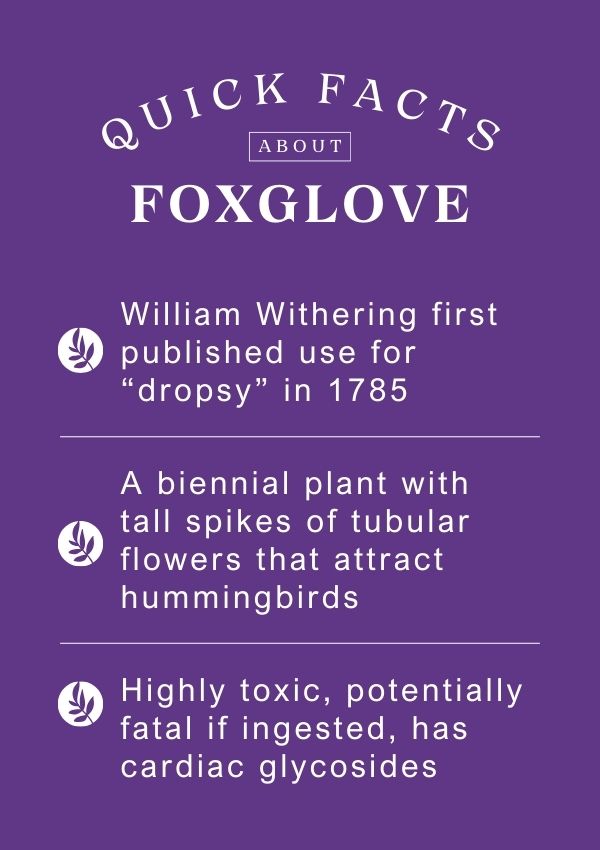
Both species contain cardiac glycosides and can be fatal if ingested.
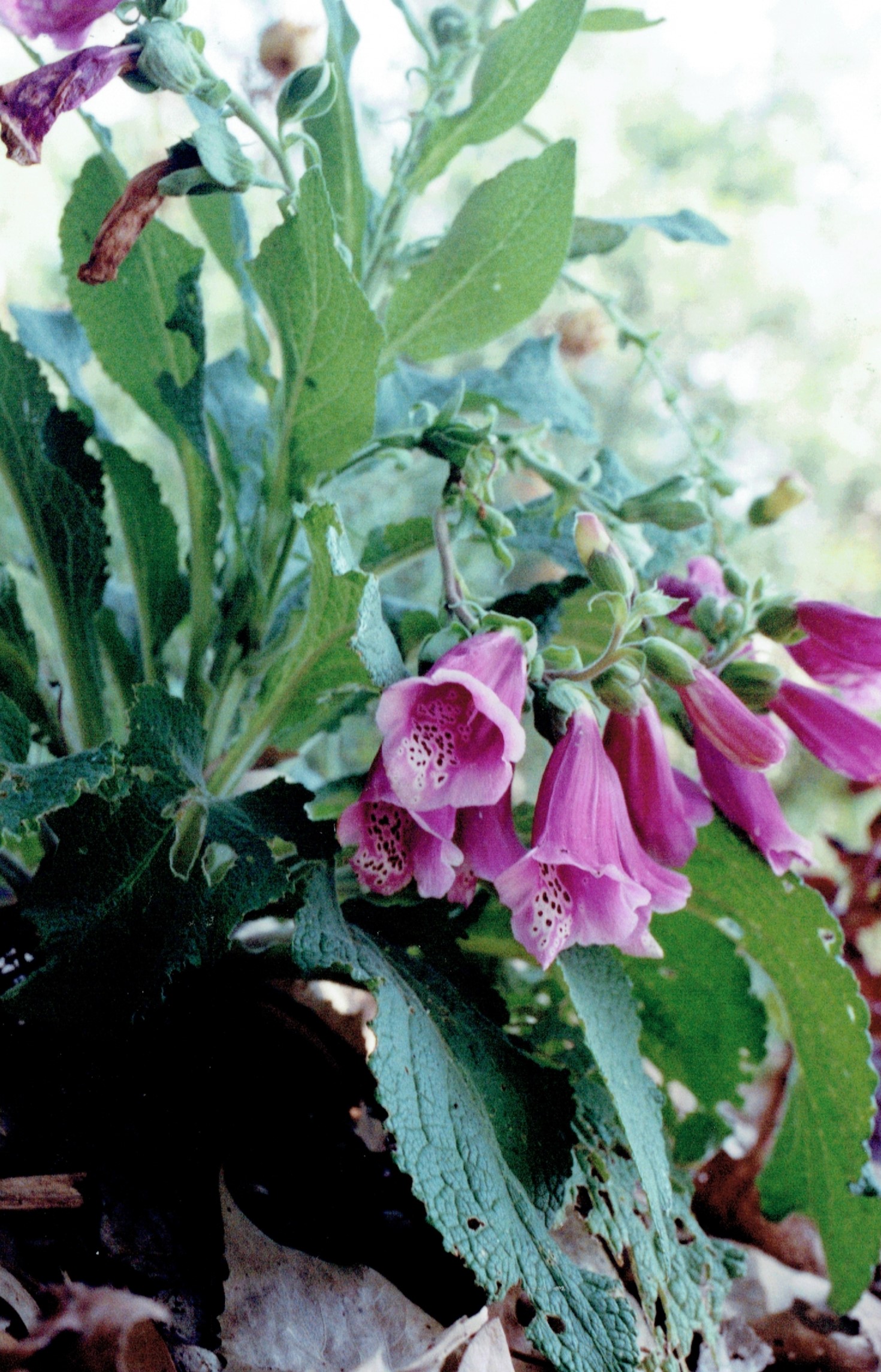
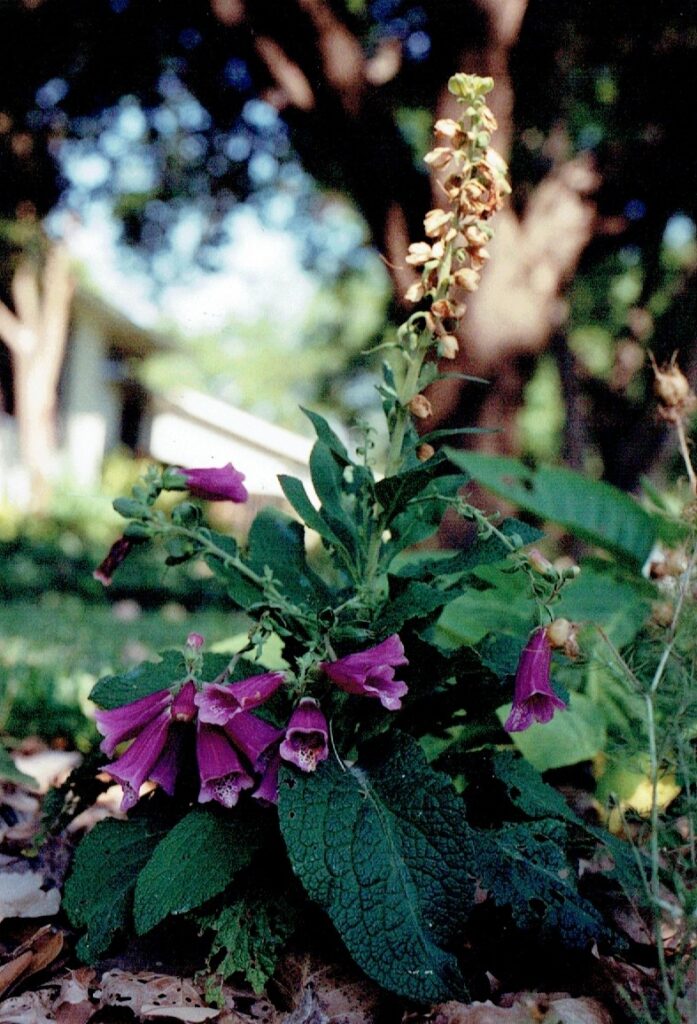
Description of Digitalis purpurea :
Growth Habit: Biennial or short-lived perennial, often grown as a cool season annual in the South.
Leaves: Basal rosette of light green woolly leaves to five inches
Blooms: Two to three inch pink, white or purple bell-shaped flowers appear on one sided racemes in
the second year of growth. The flower stalks arise from the center of the rosette and are commonly
two to four feet tall.
Seeds: Small seeds are found in many seeded capsules.
Roots: Fibrous
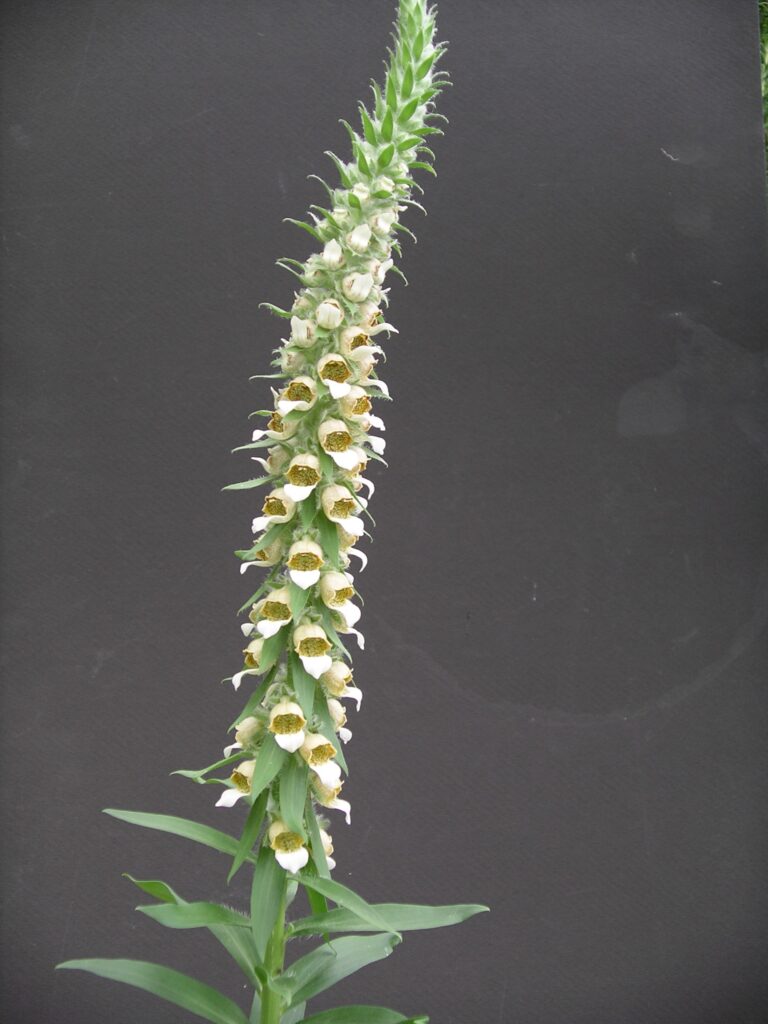
Description of Digitalis lanata :
Growth Habit: Biennial or short-lived perennial, often grown as a cool season annual in the South.
Leaves: Basal rosette of dark green leaves to five inches with hairy undersides.
Blooms: Small, cream-colored, bell-shaped flowers with purplish or brownish veins and white lips. The
flower stalks arise from the center of the rosette and are commonly two to three feet tall.
Seeds: Small seeds are found in many seeded capsules.
Roots: Fibrous
Folklore & Traditional Uses:
Sources give the origin of the botanical names Digitalis as referring to the flower shape as being like the finger of a glove with lanata referring to woolly leaves and purpurea referring to purple flowers. But one may wonder about the origin of the common name foxglove. Several theories are cited. One is that the flowers are gloves for foxes, there is an old tale that fairies gave the fox gloves to wear so he could creep silently around chicken coops. Another theory is that glove is a corruption of the Anglo-Saxon word ‘gliew’ for a collection of bells hung on a support and that the raceme of flowers were bells played either by fairies or foxes. In The Complete Book of the Flower Fairies, written by Cicely Mary Barker in 1923, her poem entitled ‘The Song of the Fox Glove Fairy’ refers to “all the fairies dancing as only they know how”. Perhaps it was to music from the “foxes-gliew”.
Digitalis has a long history of medicinal use for cardiac ailments, especially “dropsy” which we now recognize as fluid retention due to heart failure. As early as 1250 it was mentioned in herbals as treatment for symptoms of heart disease. In 1785 English physician William Withering published his account of determining that digitalis was the useful component for “dropsy” in an herbal mix in use by a Shropshire woman.
During WWII there was a shortage of pharmaceuticals in England. Staff at the Royal Botanic Gardens, Kew organized a plan to collect and dry necessary plants from rural areas. The Collecting groups were organized by the Ministry of Health and included digitalis on their list of desired herbs. The Ministry of Supply’s Herb Collectors Bulletin mentioned Boy Scouts aiding in the war effort by collecting and drying foxglove.
Modern & Medicinal Uses:
The modern medication digoxin, brand name Lanoxin, is made from the leaves of Digitalis lanata. It
was first marketed in the United States in 1954 and is still used occasionally for treatment of heart
failure or cardiac arrythmias, but there are other medications that are more frequently in use now due
to the ease of overdose with digoxin.
Toxicity
All parts of foxgloves are highly toxic, caution needs to be used when working around the plants and it
should never be ingested unless under the medical care of an experienced provider. There are
numerous reported cases of overdose and death. Symptoms of overdose are nausea and vomiting,
dizziness, sweating, heart arrhythmias, visual yellow halos and possibly death. The leaves are very
similar in appearance to those of comfrey. In 1977 a couple in Washington state quickly became ill and
both passed away when they mistakenly drank tea made from digitalis rather than the similar looking
comfrey.
Some people speculate that Vincent Van Gogh suffered from foxglove intoxication, their justification for this is that he had a preference for yellow in his paintings, there are paintings of his doctor, Dr. Gachet, holding foxglove and in the late 19th century it was used as a treatment for seizure disorder (a treatment without scientific validation). Other people argue that Van Gogh’s apparent visual disturbances were caused by his use of the liquor absinth, made from Artemisia absinthium. No one really knows…
Major Chemical Components
Many Digitalis species contain various cardiac glycosides as their active component.
Medical Botany by Lewis and Elvin-Lewis list the following as significant:
Digitalis lanata: acetyldigitoxin, deslanoside, digoxin, lanatoside C
Digitalis purpurea: digitoxin, gitaloxin, gitoxin
References:
Bender, Steve. The Southern Living Garden Book. 1998. Oxmoor House Birmingham, Alabama.
Bown, Deni. The Herb Society of America New Encyclopedia of Herbs and Their Uses. 2001. Dorling
Kindersley. London.
Khandelwal R, Vagha JD, Meshram RJ, Patel A. A Comprehensive Review on Unveiling the Journey of
Digoxin: Past, Present, and Future Perspectives. Cureus. 2024 Mar 23;16(3):e56755. doi: 10.7759/cureus.56755. PMID: 38650769; PMCID: PMC11033962.
https://pmc.ncbi.nlm.nih.gov/articles/PMC11033962/ (Accessed 9/8/2025)
Lewis, Walter H and Memory P.F. Elvin-Lewis. Medical Botany. 2003. John Wiley & Sons, Inc. Hoboken,
New Jersey.
Missouri Botanical Garden Website
https://www.missouribotanicalgarden.org/PlantFinder/PlantFinderDetails.aspx?kempercode=c530
(accessed 9/8/2025)
Pojar, Jim & Andy MacKinnon. Plants of the Pacific Northwest Coast. 1994. Lone Pine Publishing.
Canada.
Sumner, Judith. The Natural History of Medicinal Plants. Timber Press. Portland, Oregon. 2000.
Warne, Frederick. The Complete Book of the Flower Fairies. 1996. (Reproduction of 1923 text and
illustrations of Cicely Mary Barker) Penguin Books. England.
Withering, William. An Account of the Foxglove and some of its Medicinal Uses. 1785.
https://www.gutenberg.org/cache/epub/24886/pg24886-images.html (Accessed 9/15/2025)
Return to Europe Region
Return to Pharmacy Garden
It is the policy of The Herb Society of America, Inc. not to advise or recommend herbs for medicinal or health use.
This information is intended for educational purposes only and should not be considered as a recommendation or an endorsement of any particular medical or health treatment. Please consult a health care provider before pursuing any herbal treatments.