Egyptian Walking Onion
Botanical Family : Amaryllidaceae
Native to : Regions of Afghanistan, Iran, and Russia
Researched by : Julia Johnson
Botanical Family:
Amaryllidaceae, the Daffodil & Allium Family
With strap-shaped leaves and showy flowers that emerge from an underground bulb or rhizome, plants of the Daffodil & Allium family contain many ornamental plants like narcissus, agapanthus, and amaryllis as well as many important vegetable crops like onions, leeks, and garlic.
Onions are thought to have originated in the regions of Afghanistan, Iran, and Russia. They are now cultivated around the globe for their flavor and nutrition.
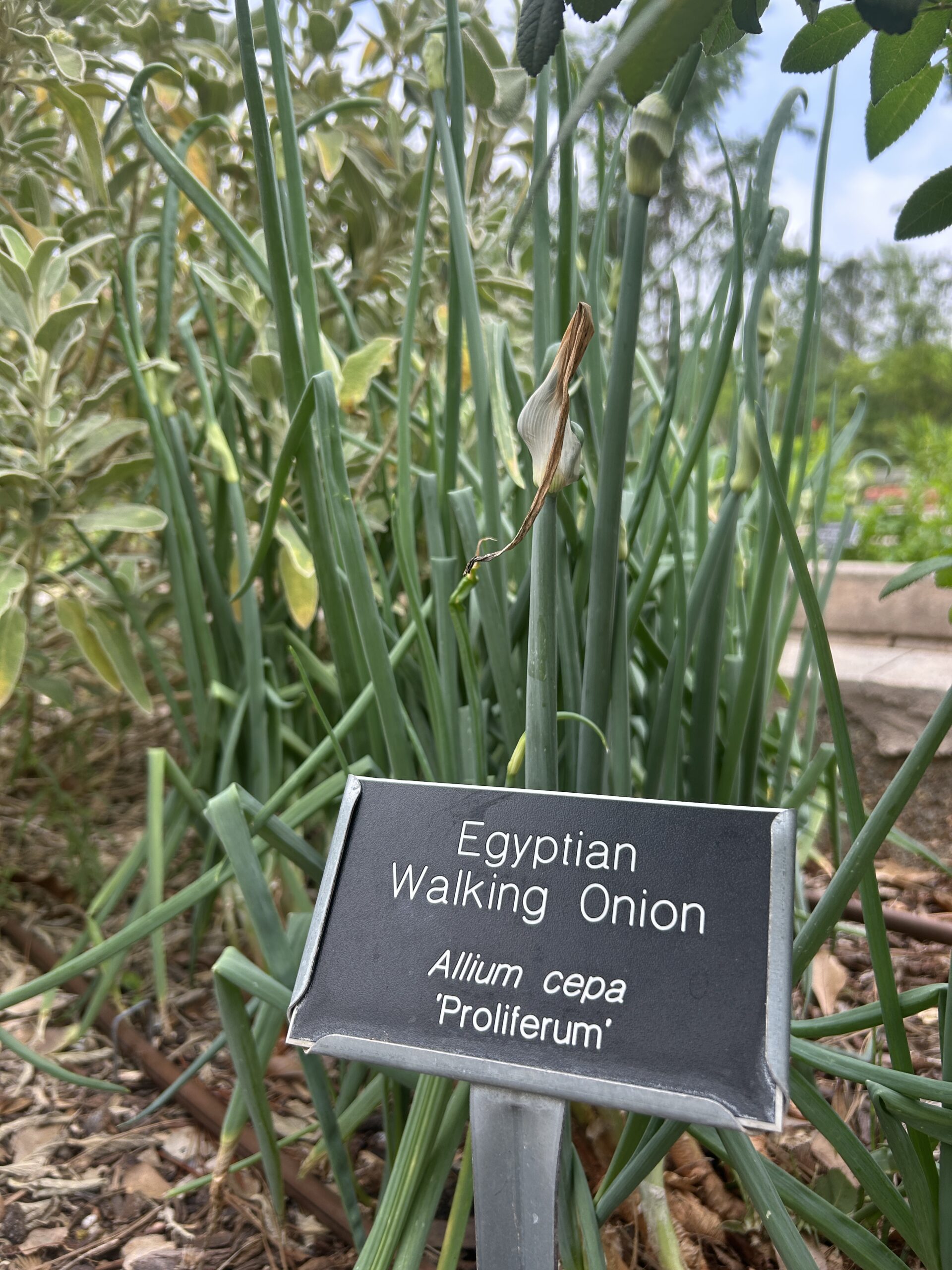
Note: Previously known as Allium cepa ‘proliferum’ as shown on our garden tag. The botanical name has recently been updated to Allium x proliferum.
Cultivation:
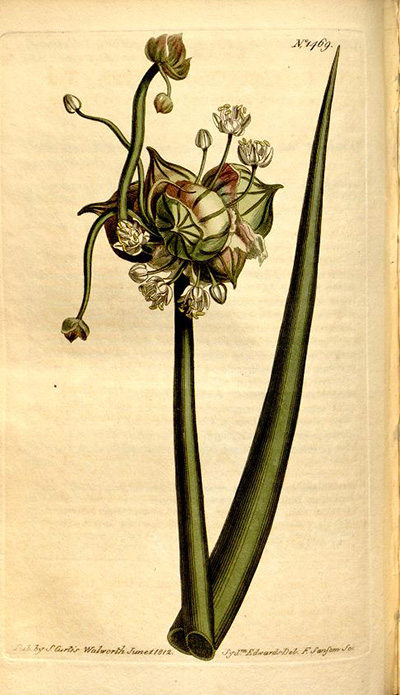
A hybrid of a bulb-type onion and the Welsh bunching onion, these meandering plants are often called walking, tree, or top-setting onions. Formerly classified as Allium cepa var. viviparum, bulbiferum, or proliferum, the Egyptian walking onion is now described as a hybrid: Allium x proliferum.
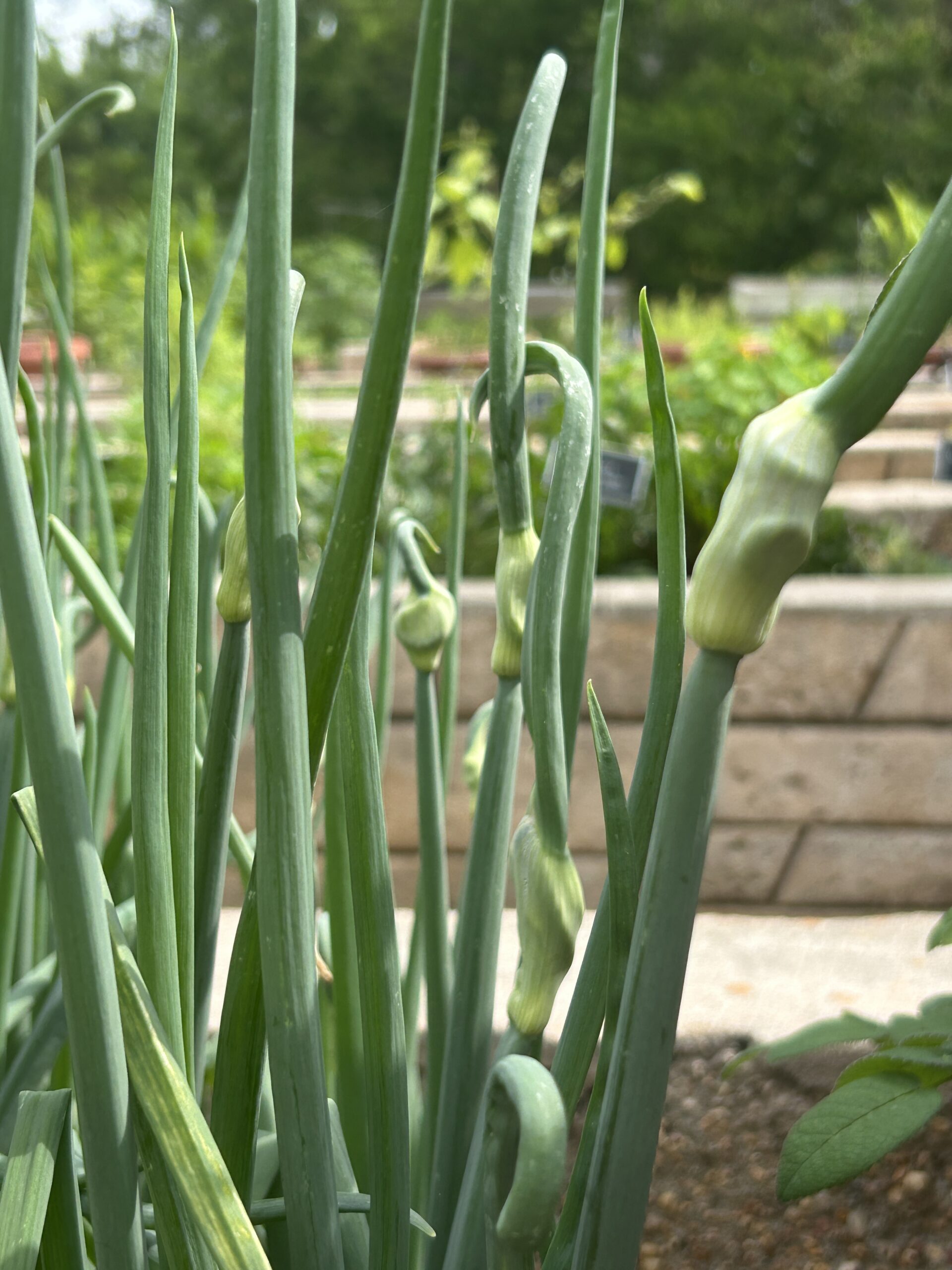
While these onions can spread further underground to form a massive clump, they spread more readily by these topsets. Being one of the first to emerge in the spring, the Egyptian walking onion sends up new leaves to start charging the onion bulb below the ground. Then on a tall stalk a little cluster of bulblets will rise, first covered in a papery covering sometimes referred to as the candlestick stage.
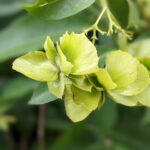
As the cluster bursts forth from the paper covering, the tiny bulblets are revealed, which may begin growing leaves of their own, giving a Medusa-like appearance to the cluster, and lending to another common name : Medusa onion.
Older clumps of these onions may even flower alongside the bulblet clusters, but generally don’t create many seeds.
As the bulblets develop and grow heavy, the hollow onion stalk will collapse to the ground. Then these bulblets quickly take root establishing new colonies of onions. In this way these top-setting onions will meander wherever you allow them to roam- you may say they “walk like an Egyptian”!
Folklore & Traditional Uses:
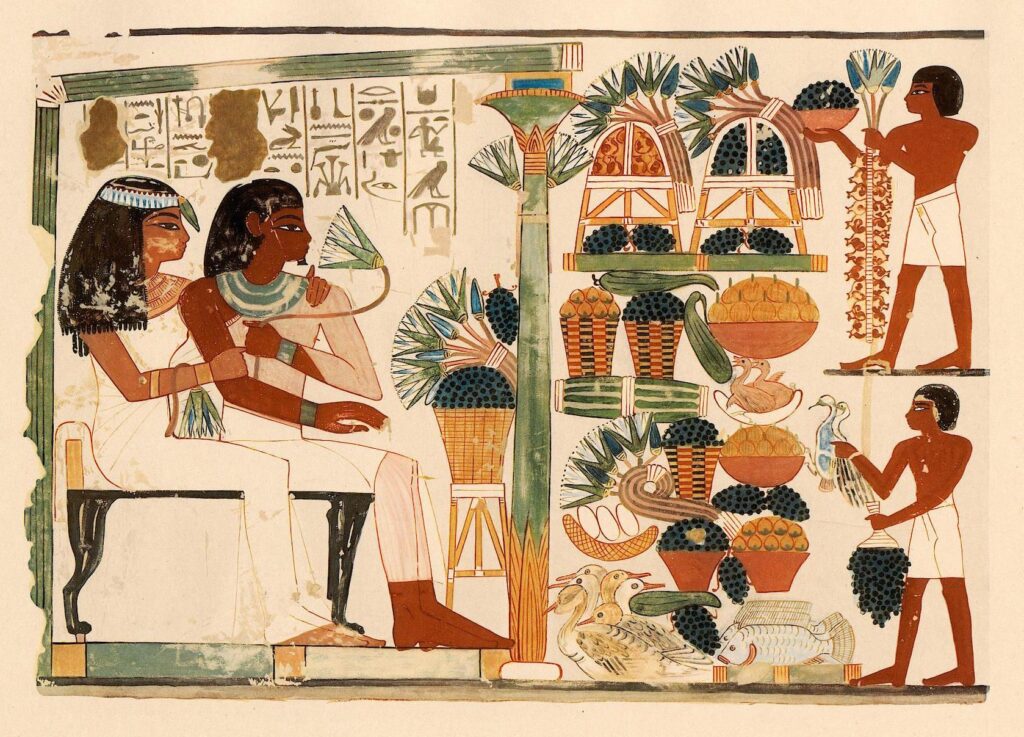
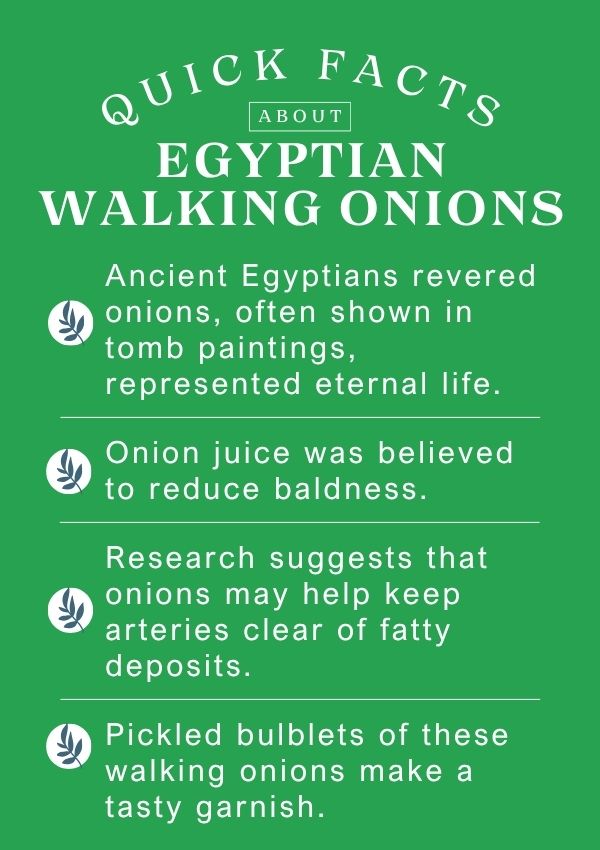
While it is not believed to have come from Egypt, it is known that Egyptians highly revered onions, it is the plant most often depicted in Egyptian tomb paintings, and were found in the eye sockets of Ramesses IV! The spherical nature of onions and their concentric rings are believed to have represented eternal life. The common name “Egyptian Walking Onion” may be an English corruption of the word “gypsy” referring to its traveling tendencies and thus became known as “Egyptian Onions”.
Greeks & Romans loved the healing properties of onions, yet hated the pungent odor. Alexander the Great would feed onions to his troops to give them added strength for battle.
A paste of onions is said to prevent infections in wounds and burns, onion extract inhibits blood clotting and may reduce cholesterol levels in people with high fat diets. Research suggests that onions increase the production of high-density lipoproteins which are believed to help clear the arteries of fatty deposits.
Rub a little onion juice on your scalp to reduce baldness.
Onion juice mixed with vinegar can erase freckles, age spots, or warts.
Sliced salted onions are said to treat burns.
Modern & Medicinal Uses:
The onion bulb is known to be anti-inflammatory, anti-parasitic, antiseptic (cleanses infection from blood), antispasmodic (reduces muscle spasms), carminative (relieves gut discomfort), diuretic, expectorant, febrifuge, hypoglycemic, hypotensive, lithontripic, stomachic and tonic
Recipes:
The pungent aroma of onions are due to sulfur compounds which travel through the bloodstream when eaten and are expressed through the pores in sweat and from the lungs when exhaled. Onions when cured are used in many foods and help to flavor meats, cheese spreads, soups, and vegetable dishes.
Green tops are versatile: chop and toss into salads, stir-fries, soups, omelets, or baked potatoes.
Bulblets or fresh bulbs, peeled and chopped, can be frozen or dehydrated for storage, or try pickling them for a tasty garnish. Roasted bulbils are great as a side with roasted meat, just toss in olive oil and season with salt and herbs before roasting. Sauté with butter for a delicious sauce, or add to soups and stews for a mild onion flavor.
Mature bulbs are great to caramelize by cooking gently in butter or oil until golden brown. Toss with olive oil and spices and roast for great flavor. Onion makes a great base for soups, stews, or other sauces.
Pickled Egyptian Onions
I found many great recipes at https://www.growwalkingonions.com/blogs/recipes, just look for Egyptian Walking Onions, and you’ll find more recipes like Tennessee Onions, Onion Pizza, and Potato Onion Pancakes! But check out this recipe for Pickled Walking Onions!
Ingredients :
2 kg Small onions
2/3 Water (of container size)
1/3 Vinegar (of container size)
2 tsp Cumin
2 tsp Coriander
5 Tbsp Salt
5 Tbsp Sugar
5 Garlic Cloves, chopped
5 Chilies, chopped
2 Bay Leaves
Instructions :
- Fill half-gallon jar with small onions, fill with boiling water to soak. Meanwhile peel & chop garlic and chilies. Drain.
- Refill jar with more boiling water and set 5-10 min, then drain again, this helps remove any bitterness. Then add spices, salt, sugar, garlic, and chilies to jar, top with the two bay leaves. Add more boiling water to fill the jar 2/3 full, then top with distilled vinegar the last 1/3 of the jar.
- Securely close the top of the jar and shake well to combine. Place in the refrigerator for 3 days and enjoy!
Onion Pie
Ingredients:
3 large onions, thinly sliced
Olive oil
Butter
Salt
Sugar
Paprika Peppers / Bell Peppers
4 eggs
Pepper
1/2 cup cream
1 glass flour
Chives / Scallions
Breadcrumbs
Cheese Feta
Cherry Tomatoes
Cheese
This recipe found online looks very tempting, watch the YouTube video for visual instructions here. https://www.youtube.com/watch?v=hOIy2u-cSYA Basic instructions are as follows:
- Slice onions, then saute in olive oil and butter until nicely caramelized. Halfway through season with salt and pepper.
- Meanwhile, chop bell peppers, Chives/Scallions, and place in a bowl.
- Next combine eggs, salt & pepper to taste, 1/2 c cream, flour. (about a cup of flour I think).
- After onions are caramelized, cool slightly and combine with egg-flour mixture.
- Grease an oven safe skillet, sprinkle with breadcrumbs. Pour about 2/3 of your egg-flour-onion mixture into the skillet. Then add the peppers and scallions. Cube up a block of Feta, and toss on next. Top with remaining egg-flour-onion mixture. Then add some shredded cheese (unspecified, try your favorite!) and finally top with some halved cherry tomatoes, cut side facing up.
- Bake at 350F for 35 minutes, until lightly browned. Better than pizza!
References:
Kowalchik & Hylton. Rodale’s Illustrated Encyclopedia of Herbs. Emmaus, Pennsylvania : Rodale Press, 1998. Print.
Chakraborty AJ, Uddin TM, Matin Zidan BMR, Mitra S, Das R, Nainu F, Dhama K, Roy A, Hossain MJ, Khusro A, Emran TB. Allium cepa: A Treasure of Bioactive Phytochemicals with Prospective Health Benefits, https://pmc.ncbi.nlm.nih.gov/articles/PMC8789449/, Accessed on : 7/29/25.
Suwak, Matt, “How to plant and grow Egyptian Walking Onions”, Gardener’s Path, October 16, 2022, https://gardenerspath.com/plants/vegetables/grow-egyptian-walking-onions/, Accessed on 7/29/25.
Paine, Tracy, “All About the onion that walks”, Egyptian Walking Onion, https://www.egyptianwalkingonion.com/, Accessed on 7/29/25.
Return to Middle East
Return to Pharmacy Garden
It is the policy of The Herb Society of America, Inc. not to advise or recommend herbs for medicinal or health use.
This information is intended for educational purposes only and should not be considered as a recommendation or an endorsement of any particular medical or health treatment. Please consult a health care provider before pursuing any herbal treatments.