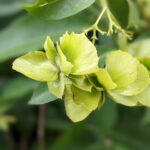
Toothache plant, Jambu, Eyeball plant, Paracress, Szechuan buttons, Buzz buttons, Tingflowers and Electric daisy
Botanical Family : Asteraceae
Native to : South America
Researched by : Wendy Matthews

Botanical Family:
Asteraceae (previously Compositae)
This is one of the largest families of flowering plants with over 25,000 species.
Previously known as: Spilanthes acmella.
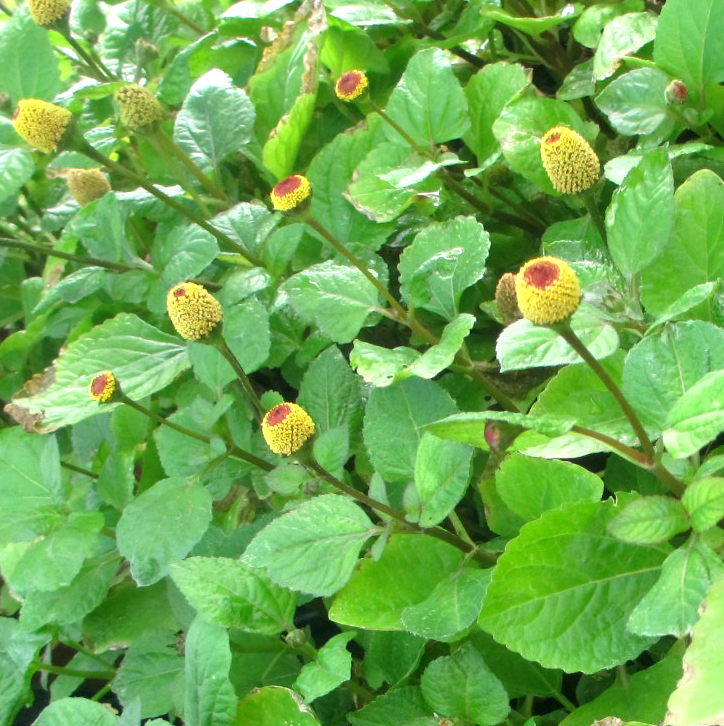
The center is composed of many small flowers clustered into a head. Some species have petals surrounding this cluster, however, in the case of Acmella, only the center flower cluster is present.
The specific epithet oleracea means “vegetable/herbal” in Latin.
Daisies, sunflowers, and lettuce are some members of this family.
Cultivation:
This herbaceous plant is native to rainy, humid regions of Brazil.
It is winter hardy in US Zones 9-11. Although a perennial in its native region, it should be treated as an annual or overwintered indoors in areas that may receive frost. Grow in moist, well-drained soil in full sun or part shade. It is propagated by seed and can grow up to 1.5 feet tall and wide.
Acmella attracts fireflies, bees, butterflies, and birds.
Blooms : The yellow and maroon cone-shaped flowers are produced throughout the growing season.
Foliage : Opposite deltoid to ovate leaves 2-3 inches long and wide
Pests : Aphids, mealybugs, and spider mites will occasionally affect Acmella, but these are easily sprayed off with water.
Folklore & Traditional Uses:
Acmella oleracea is believed to have originated in Brazil and has now spread throughout tropical America, Africa, and India. The oldest record of cultivation is from St. Vincent in the Caribbean in 1791.
The most common and widespread medicinal use is to treat toothache and throat and gum infections. The flowers were traditionally chewed by people living in the Amazon to relieve mouth, tooth, and throat pains, hence, the common name of “toothache plant”. This traditional use has led to modern research as a possible analgesic agent.
Historically, the plant has been claimed to cure scurvy.
Other traditional uses include treatment for snakebite, tuberculosis, rheumatism, malaria and other fevers. A decoction of the plant has been used in Brazil as an antiseptic. The Peruvians also used Acmella as an insecticide against the yellow fever mosquito and corn earworm moth and as an anti-parasitic.
Modern & Medicinal Uses:
Chemical composition and mechanism of action :
The leaves are rich in vitamins A, C, and K, lutein, and magnesium. Ingestion of the flowers causes a strong tingling sensation and increased production of saliva. The main active chemical is the alkamide spilanthol. It is closely related to sanshool which is the chemical in Szechuan pepper. Spilanthol is found in higher concentrations in the flowers of the plant than in the leaves. This extract reduces the perception of pain by targeting the pain-mediating receptors CB1, CB2 and TRPV1.
Additional properties :
In addition to its antinociceptive (pain perception blocking) property, research shows A. oleracea to have antioxidant, anti-inflammatory, antimicrobial, antifungal, diuretic, vasorelaxant, and immunomodulatory properties. Spilanthol, phenolics, flavonoids, coumarins, and triterpenoids are thought to be responsible for these effects. The plant also contains rhamnogalacturonan which has been shown to inhibit stomach ulcers. Laboratory studies have shown spilanthol to have insecticidal activity against mosquitos, the Egyptian cotton worm, and various ticks. Many flowers are needed to produce concentrated spilanthol extract. Efficient chemical synthesis of spilanthol has yet to be developed.
Toxicity :
No clinical human trials have been done on Acmella, but it is generally considered safe. Care should be exercised if pregnant, using diuretics (Acmella can have a diuretic effect), or are taking drugs for prostate cancer (can increase testosterone).
Avoid it if you are allergic to members of the Asteraceae family.
Recipes:
Leaves can be added to salads to add a pungent flavor. Flowers are also edible in small quantities. An extract, sometimes called jambu, is used as a flavoring agent in foods, chewing gum, and chewing tobacco.
“Tacacá,” a spicy, sour soup from the Brazilian Amazon, is made from tucupi (fermented cassava juice), prawns and Acmella leaves.
Another Brazilian recipe is “Pato no tucupi” which contains duck, garlic, Acmella leaf, and lemon.
The leaves are sometimes pan-fried, chopped, and mixed into rice cooked with onion and garlic.
Romazava is called Madagascar’s national dish and is a stew of meat, tomatoes, onions, garlic, ginger, red peppers and Acmella leaves.
Cachaça is a distilled spirit made in Brazil which can be infused with either leaves or the more potent flowers, to create a shot that is both numbing and strong. Leodoro Porto, proprietor of Meu Garoto bar in Belém, is credited with creating the first jambu-infused cachaça back in 2011. Around 2018 jambu cachaça brands started cropping up outside of Pará, which made it available to a national audience. Cachaça Meu Garoto Jambu is currently available for sale online.
References:
“Acmella Oleracea (Buzz Buttons, Electric Daisy, Eyeball Plant, Paracress, Sichuan Buttons, Toothache Plant) | North Carolina Extension Gardener Plant Toolbox.” Ncsu.edu, 2021, plants.ces.ncsu.edu/plants/acmella-oleracea/. Accessed 14 July 2025.
Bown, Deni. New Encyclopedia of Herbs & Their Uses. New York: DK Publishing, Inc., 2001.
Mardell, Jacob. “Brazil’s Answer to the Sichuan Pepper.” Bbc.com, BBC, 8 July 2022, http://www.bbc.com/travel/article/20220707-brazils-answer-to-the-sichuan-pepper. Accessed 14 July 2025.
“Brazil’s Mouth-Numbing Jambú Plant Is a Taste Sensation You’ve Never Had.” Matador Network, 18 Jul 2019, matadornetwork.com/read/brazils-jambu-plant-recipes/, Accessed 14 July 2025.
“Acmella Oleracea Toothache Plant, Paracress PFAF Plant Database.” Pfaf.org, pfaf.org/User/Plant.aspx?LatinName=Acmella+oleracea, Accessed 14 July 2025.
Vasquez, Nicholas C., “Acmella Oleracea: The Toothache Plant.” mecklenburghsquaregarden.org.uk, 1 July 2017, mecklenburghsquaregarden.org.uk/acmella-oleracea-the-toothache-plant/ Accessed 14 July 2025.
Aktar, M.A., Bhuia, M.S., Molla, S. et al. “Pharmacological and phytochemical review of Acmella oleracea: a comprehensive analysis of its therapeutic potential.” Discov Appl Sci , vol. 6, no. 8, 30 July 2024. https://doi.org/10.1007/s42452-024-06108-5
“Spilanthes Acmella | Memorial Sloan Kettering Cancer Center.” http://www.mskcc.org, 24 February 2022, http://www.mskcc.org/cancer-care/integrative-medicine/herbs/spilanthes-acmella-jambu, Accessed 14 July 2025.
Return to South America Region
Return to Pharmacy Garden
It is the policy of The Herb Society of America, Inc. not to advise or recommend herbs for medicinal or health use.
This information is intended for educational purposes only and should not be considered as a recommendation or an endorsement of any particular medical or health treatment. Please consult a health care provider before pursuing any herbal treatments.