Túa-túa, Bellyache Bush, Cotton-leaf Physic Nut, Cotton-leaf Jatropha, Black Physic Nut
Botanical Family : Euphorbiaceae
Native to : American Tropics
Researched by : Wendy Matthews
Botanical Family:
Euphorbiaceae
Also known as the spurge family, Euphorbiaceae has a worldwide distribution, but the greatest number of species are found in the tropics. Crotons, castor oil plant, and poinsettia are all in this family. A related species, Jatropha curcas, can be used for making biodiesel.
Cultivation:
Jatropha gossypiifolia is native to tropical America, but has now spread throughout the tropics. It is somewhat succulent, and can grow to 10 feet in frost-free areas. This plant is hardy only in US zones 9-11, but can be grown as an annual in colder areas. It needs good drainage and full sun or light shade. This jatropha seeds out profusely, but the seedlings are easily pulled out.
Growth Habit
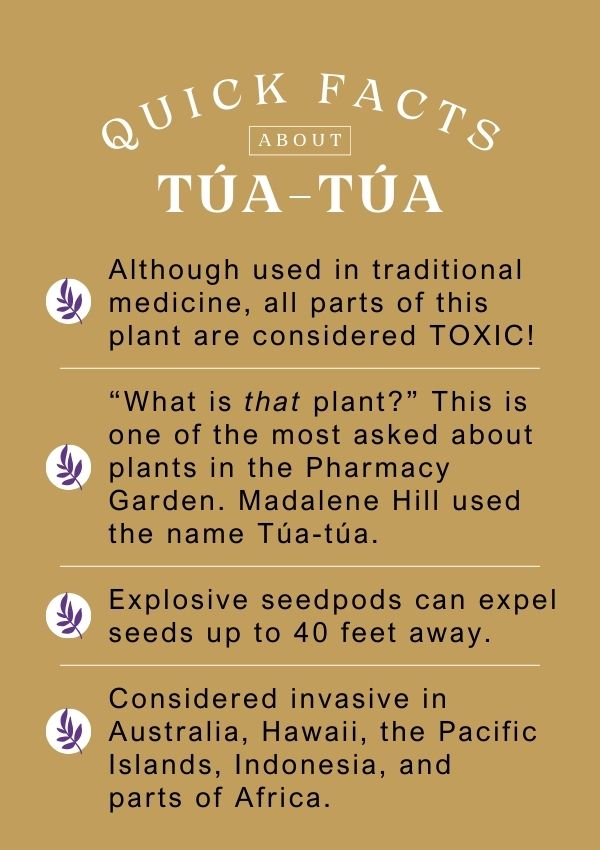
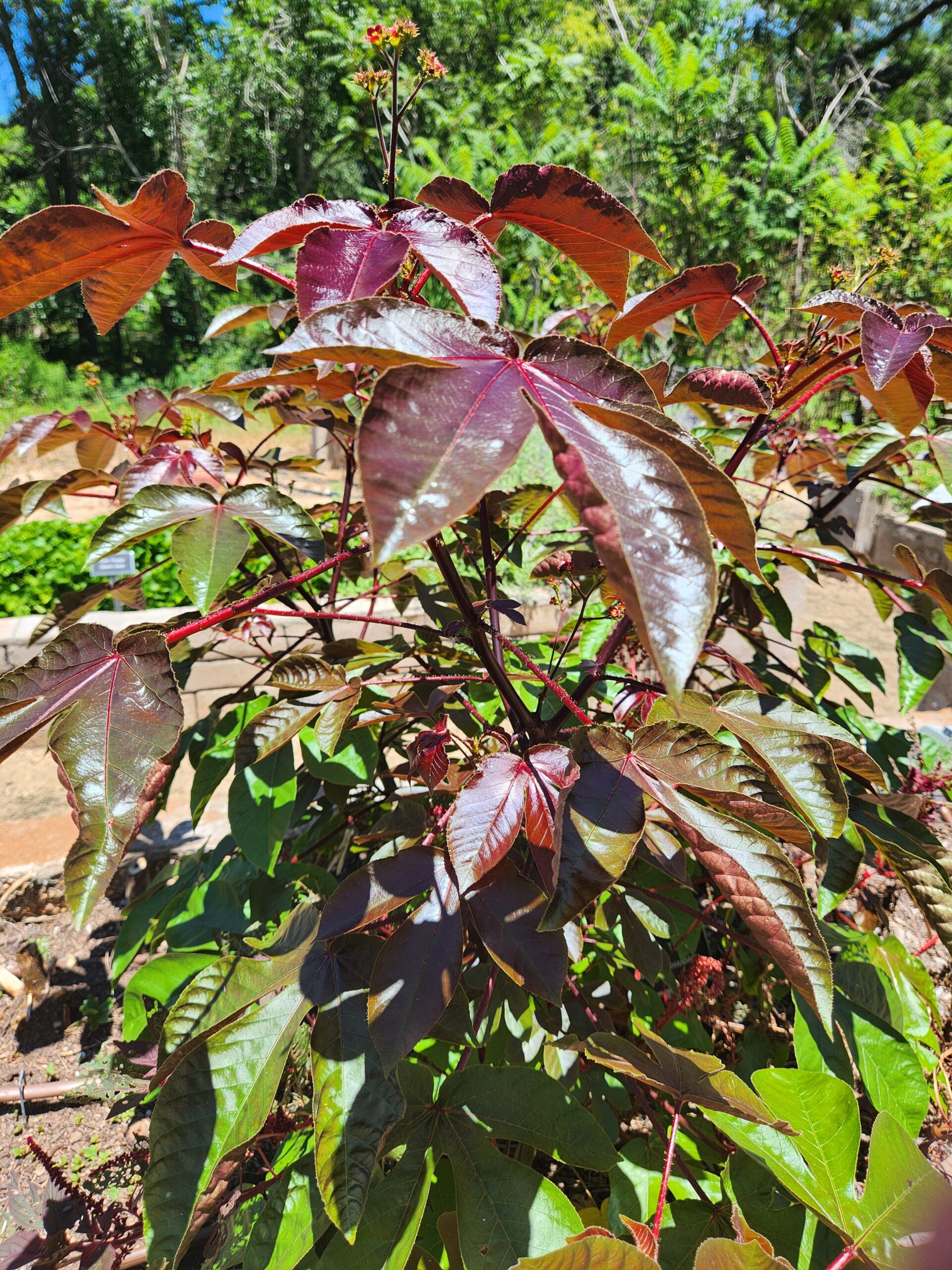
The plant has a single, somewhat succulent stem topped by an open sparse canopy. The younger branches are purplish and densely covered in hairs. The leaf stalks are 2-6 inches long and have sticky hairs. At Festival Hill, Túa-túa grows as an annual and often reaches a height of 4 feet in a season.
Leaves
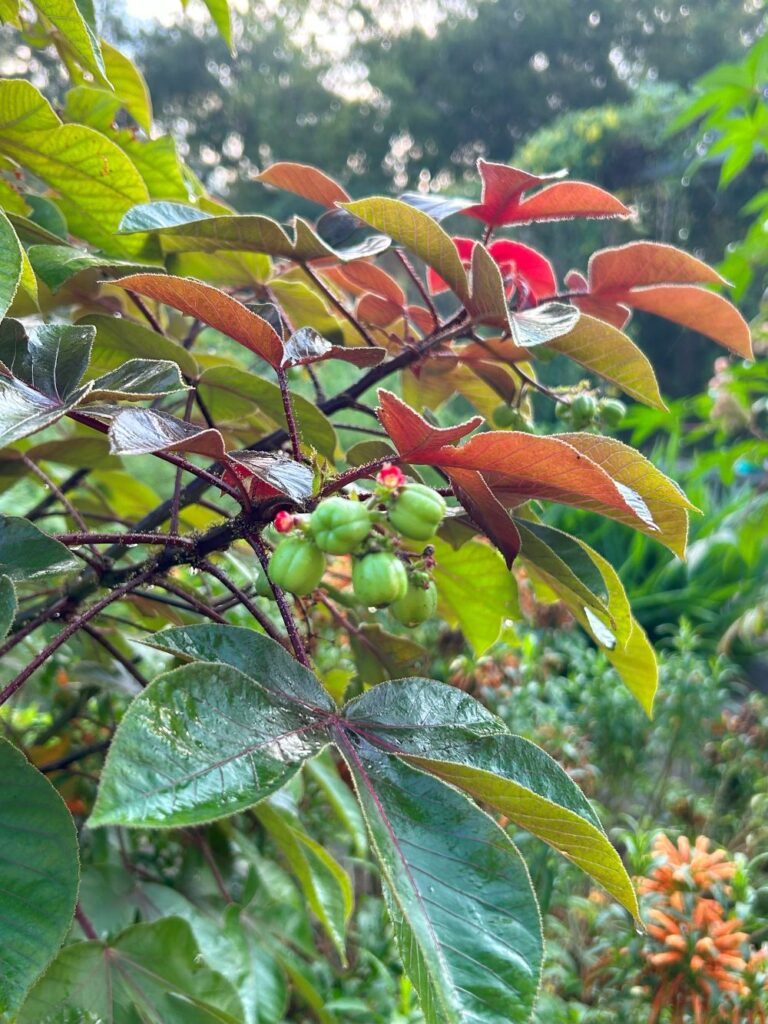
The alternately arranged 3 to 5 lobed leaves are up to 3 inches long and 6 inches wide. They are dark reddish-purple when young and green when older.
Flowers
The flowers are small, bell-shaped, and dark red with yellow centers. They are borne in clusters in the upper leaf forks. Plants can begin to flower in two months, and can flower all year round if there is sufficient soil moisture.
Fruit
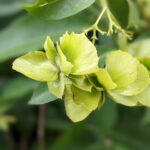
The fruits are three-lobed fleshy capsules up to a half and inch in diameter that hang off petioles measuring up to 2 and a half inches long. These capsules are glossy green in color, and each one contains three gray-brown seeds. The seeds are explosively released and can travel up to 40 feet!
Environmental impact
Túa-túa has escaped in many areas of the tropics and become naturalized. It is an opportunistic colonizer of disturbed habitats and is frequently found in areas where the natural vegetation has been over-grazed or removed by human activity or floodwaters. In northern Australia it has become a noxious weed and often forms dense thickets. It is considered invasive in Australia, Hawaii and the Pacific Islands, Indonesia, and parts of Africa.
Pests
Jatropha is occasionally bothered by mealy bugs, scale, and whitefly.
Folklore & Traditional Uses:
Although poisonous, the plant is often harvested from the wild for local use in traditional medicine. Jatropha species are used in traditional medicine to cure various ailments in Africa, Asia, and Latin America. Both human and veterinary uses are described for this plant. Leaves, stems, roots, seeds, and latex are used, preparations include infusion, decoction, and maceration and the routes of administration can be oral or topical.
Internal*
An oil obtained from the seeds is a powerful purgative and emetic, and is taken to expel internal parasites. The leaves are considered a blood purifier, febrifuge, purgative and are used for treating venereal disease, heart problems, stomach ache and indigestion. The dried and pulverized root bark is made into poultices and is taken internally to expel worms and to treat edema. The whole plant has been popularly used in Costa Rica for treating cancers. It has also been used as a contraceptive.
External
A poultice of the leaves is used for treating sores, bruising, swellings, inflammations, and headaches. The sap is used for healing wounds, stopping bleeding and for curing skin problems. Topically, it is used for wound infections, ulcers, cuts, abrasions, ringworm, eczema, scabies and venereal diseases. It is also used for snakebite and bee and wasp stings.
*Please see Toxicity Concerns below
Modern & Medicinal Uses:
In Brazil, J. gossypiifolia is included in the National List of Medicinal Plants of Interest to the Brazilian Public Health System (Relação Nacional de Plantas Medicinais de Interesse ao Sistema Único de Saúde Brasileiro—RENISUS), which is a report published by the Brazilian Health Ministry that includes species of medicinal plants that have the potential to generate pharmaceutical products of interest to public health of Brazil.
Toxicity Concerns
All parts of J. gossypiifolia are considered toxic, especially the seeds. Children are at greater risk of toxicity, and the fruit and seeds of J. gossypiifolia are especially attractive to children. In humans there is acute abdominal pain and a burning sensation in the throat about half an hour after ingesting seeds, followed by nausea, vomiting, and diarrhea. In severe poisonings, dehydration and hemorrhagic gastroenteritis can occur, as well as central nervous system and cardiovascular depression and collapse. Jatropha sap or latex can cause acute dermatitis on contact. The fruits of the plant are poisonous to both humans and animals.
Chemical Constituents
J. gossypiifolia roots contain the diterpenes jatropholone and jatrophone. The coumarin-lignoid gossypidien is found in the stems, and the latex contains the protein cyclogossine. The lignans gossypiline and gossypifan are found in the aerial parts. In addition, phytochemical investigations have revealed the presence of phenols, starch, saponins, glycosides, organic acids, steroids, carbohydrates, flavonoids, alkaloids, and terpenoids.
Current Research
An alcoholic root extract of J.gossypiifolia showed significant inhibitory activity in different human cancer cell lines. This finding led, in 1970, to the isolation of the macrocyclic diterpenes jatrophone and related jatrophanes.
Jatropholones are diterpenoid compounds, which are organic molecules characterized by their multi-ring chemical structure. Jatropholone B inhibits cellular proliferation and induces apoptosis (cell death) in cancer cells. This is achieved through the modulation of various signaling pathways, leading to its potential use as an anticancer agent. Jatropholones have also been shown to have protective effects on the gastric system.
Jatrophone is a diterpene which has been shown to have cytotoxic activity to breast cancer cells and glioblastoma cells. It also has antiviral activity and has direct inhibitory effects on contractions of cardiac and smooth muscle preparations.
Extracts have been found to inhibit the malarial parasite Plasmodium falciparum in vitro, and extracts of the fresh fruits showed significant activity against fungi and some bacteria. Stem sap was found to inhibit the growth of some plant fungal diseases. Extracts also exhibited toxicity to tick larvae and to freshwater snails that cause snail transmitted parasitic diseases. Additional research done with extracts of J. gossypiifolia in vitro or in animals have shown antihypertensive, antimicrobial, anti-inflammatory, hemostatic, antioxidant, and contraceptive activity.
References:
“Cotton-Leaved Physic-Nut, Bellyache Bush, Cotton-Leaf Physic Nut, Cotton-Leaf Jatropha, Black Physic Nut.” Weeds.org.au, 2019, weeds.org.au/profiles/cotton-leaved-physic/.
“Euphorbiaceae in Flora of North America @ Efloras.org.” Efloras.org, 2025, http://www.efloras.org/florataxon.aspx?flora_id=1&taxon_id=10327.
WoS. “Jatropha Gossypiifolia (Bellyache Bush).” World of Succulents, 30 Jan. 2019, worldofsucculents.com/jatropha-gossypiifolia-bellyache-bush/.
Faiz Bebawi. “Jatropha Gossypiifolia (Bellyache Bush).” CABI Compendium, CAB International Publishing, Jan. 2022, https://doi.org/10.1079/cabicompendium.28394.
“Jatropha Gossypiifolia – Useful Tropical Plants.” Theferns.info, 2025, tropical.theferns.info/viewtropical.php?id=Jatropha+gossypiifolia.
Félix-Silva, Juliana, et al. “Jatropha Gossypiifolia L. (Euphorbiaceae): A Review of Traditional Uses, Phytochemistry, Pharmacology, and Toxicology of This Medicinal Plant.” Evidence-Based Complementary and Alternative Medicine, vol. 2014, 2014, pp. 1–32, https://doi.org/10.1155/2014/369204.
“Jatropholone B.” Biosynth.com, 2025, http://www.biosynth.com/p/WCA38638/71386-38-4-jatropholone-b. Accessed 8 Aug. 2025.
Fatokun, Omolola, et al. “Phytochemistry, Ethnomedicine and Pharmacology of Jatropha Gossypiifolia L: A Review.” Archives of Current Research International, vol. 5, no. 3, Jan. 2016, pp. 1–21, https://doi.org/10.9734/acri/2016/28793. Accessed 8 Aug. 2025.
Shari, Khawlah, et al. “Jatrophone: A Cytotoxic Macrocylic Diterpene Targeting PI3K/AKT/NF-ΚB Pathway, Inducing Apoptosis and Autophagy in Resistant Breast Cancer Cells.” BMC Complementary Medicine and Therapies, vol. 23, no. 1, BioMed Central, Aug. 2023, https://doi.org/10.1186/s12906-023-04113-6. Accessed 8 Aug. 2025.
Li, Kai, et al. “Anti‐Viral Activity of Jatrophone against RSV‐Induced Respiratory Infection via Increase in Interferon‐γ Generating Dendritic Cells.” Environmental Toxicology, vol. 35, no. 8, Apr. 2020, pp. 888–94, https://doi.org/10.1002/tox.22925. Accessed 8 Aug. 2025.
Sabandar, Carla W., et al. “Medicinal Property, Phytochemistry and Pharmacology of Several Jatropha Species (Euphorbiaceae): A Review.” Phytochemistry, vol. 85, Jan. 2013, pp. 7–29, https://doi.org/10.1016/j.phytochem.2012.10.009. Accessed 8 Aug. 2025.
Majeed, Ismat, et al. “Ethnotraditional Uses and Potential Industrial and Nutritional Applications of Secondary Metabolites of Genus Jatropha L. (Euphorbiaceae): A Review.” Journal of Agriculture and Food Research, Elsevier BV, Mar. 2025, pp. 101861–61, https://doi.org/10.1016/j.jafr.2025.101861. Accessed 8 Aug. 2025.
S. Morris Kupchan, et al. Jatrophone, a Novel Macrocyclic Diterpenoid Tumor Inhibitor from Jatropha Gossypiifolia. no. 14, July 1970, pp. 4476–77, https://doi.org/10.1021/ja00717a066. Accessed 8 Aug. 2025.
Return to Central America Region
Return to Pharmacy Garden
It is the policy of The Herb Society of America, Inc. not to advise or recommend herbs for medicinal or health use.
This information is intended for educational purposes only and should not be considered as a recommendation or an endorsement of any particular medical or health treatment. Please consult a health care provider before pursuing any herbal treatments.