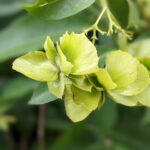
Pineapple and Ananas
Spanish: piña
Javanese and Malay: nanas
Filipino: apangdan
Thai: yaannat, sapparot, or bonat
Botanical Family : Bromeliaceae
Native to : American Tropics
Researched by : Wendy Matthews
Botanical Family:
Bromeliaceae
Bromeliads are herbaceous perennials found mostly in the tropics of the Americas. An exception is Spanish moss or Tillandsia usneoides which can grow in temperate regions. Bromeliads are monocots and can be epiphytic (air plants) or terrestrial (grow in soil). Many have stiff leaves which are arranged to hold water. The flowers are insignificant, but the bracts which are modified leaves are often colorful. Most are monocarpic, meaning they flower only once. They are propagated by “pups” which develop alongside the mother plant.
Cultivation:
Morphology
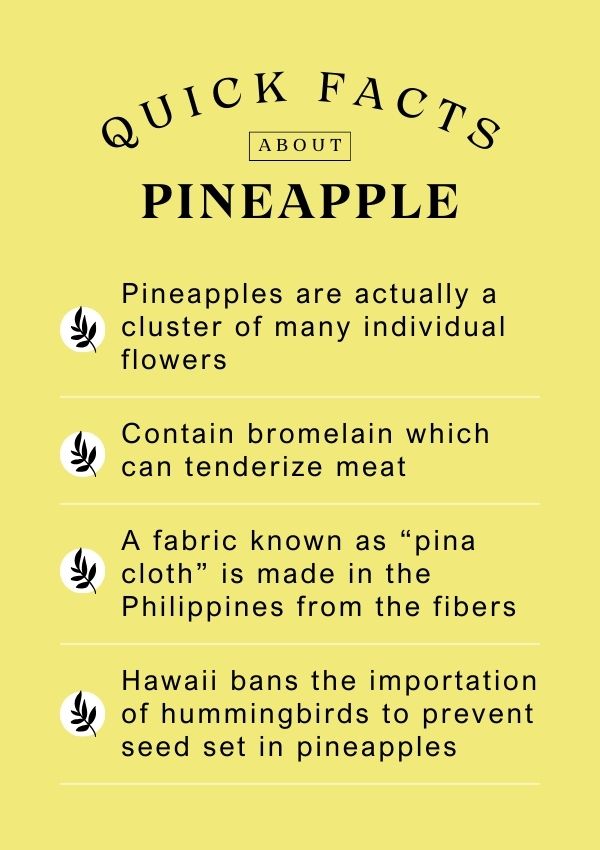
The pineapple plant is a terrestrial bromeliad that can grow 3 to 5 feet in height and width. It is a herbaceous perennial with trough-shaped, pointed leaves arranged in a rosette. These leaves may or may not have spines along their edges, depending on the variety and growing conditions. For new plants, the leaves are typically 2 to 8 inches long, while mature plants can have leaves up to 5 feet long. Once the plant has produced between 70 and 80 leaves, it is ready to flower. Pineapples bloom in the summer, and the flower cluster, which may contain 50 to 200 individual flowers, is topped with a crown of numerous short leaves. The flower cluster is supported by a stalk that can be up to 20 inches long, and this stalk eventually swells and ripens into the pineapple fruit. It generally takes 2 to 3 years for the plant to produce fruit. Pineapples are pollinated by hummingbirds; however, because seeds make the fruit less desirable commercially, Hawaii has banned the importation of hummingbirds.
Cultivation
Pineapples are reliably hardy only in frost-free areas (US Zones 10-11). They may survive brief temperatures of 28°F, but the plant will be damaged. They can be grown in containers and overwintered indoors, but consider the sharp points if you choose this method. Bring inside when temperatures fall below 50°F. Pineapples prefer acidic, loose, sandy, organically rich, well-drained soils. They perform best in moderate to high humidity, with temperatures between 65 to 90°F, and a soil pH of 4.5-6.5. Pineapples should have full sun or part shade. They are tolerant to drought but as they like high humidity, plants can benefit from spraying their leaves with water during hot, dry periods.
Propagation
Pineapple is propagated by planting either the fruit crown, suckers produced at the base of the plant, or slips that form on the inflorescence below the flowers. The fruit crown refers to the top of the pineapple. To propagate using the crown, cut it off about an inch below the leaf cluster. Trim away the outer fruit flesh and a few of the lower leaves, leaving some of the inner core intact. Allow the cut end to dry for about a week to discourage rotting. This method is the slowest way to grow a pineapple and can take at least 24 months to produce fruit.
Pests
Mites, scales, thrips, nematodes and mealy-bugs are some of the pests that can affect pineapples. Fungal and bacterial pathogens can lead to root rot.
Folklore & Traditional Uses:
History
The word “Ananas” is believed to have originated from an indigenous Brazilian word for the fruit, while cosmosus refers to “tufted.” European explorers adopted the word “piña” due to the fruit’s resemblance to a pinecone.
It is thought that the pineapple originated in pre-Columbian times in South America and underwent various mutations that increased its juiciness and sweetness. There are two hypotheses about the possible origin of the pineapple. One suggests that pineapples were domesticated from a wild species by the Tupi-Guarani Indians in Brazil, who carried them during their migration northward to the Antilles, northern Andes, and Central America. The second hypothesis proposes that modern pineapples originated in the Paraná-Paraguay river drainage area.
Regardless, pineapples were already a part of the diet of the Native Americans before the arrival of Columbus. In the late 15th century, Europeans documented pineapple domestication in parts of South America and the Caribbean. Pineapple was introduced into the Philippines, Hawaii and Guam during the early 16th Century by the Spaniards, and reached India and the east and west coasts of Africa by 1548. In 1594, pineapple plants were reported growing in China and by 1655 in South Africa. Pineapple plants were reported in Europe in 1650 and pineapple fruits were being produced in Holland in 1686. It was not until 1719 that pineapple plants were successfully established in England in greenhouses. In 1777, Captain James Cook planted pineapples in the South Pacific. The first sizable plantation was established in Oahu in 1885, and with the development of refrigerated transport, production shifted from the West Indies to Hawaii, Asia, and Africa.
Traditional Uses
The indigenous Brazilians consumed pineapple fresh and also fermented the juice into an alcoholic beverage. Medicinal uses included its use as an abortifacient (not supported by current research), for menstrual disorders, and for healing wounds and treating digestive disorders. It was also used as an antiparasitic. The fibers from the leaves were used to produce ropes, fishing lines and nets, hammocks, and clothing.
Modern & Medicinal Uses:
Pineapple is grown mainly for fresh or canned fruit, and currently the top three producers are Costa Rica, the Philippines and Brazil. The pineapple cultivar Smooth Cayenne is the most widely grown.The US is the largest importer of pineapples.The fruit is a good source of vitamin C, manganese and fiber. Pineapple is used as a flavoring for various processed food products.
Pineapple contains the proteolytic enzyme bromelain, which is used as a meat tenderising agent and for medicinal purposes. Bromelain is a mixture of proteolytic enzymes which belong to the cysteine protease family. The composition of bromelain can vary depending on the source of extraction (fruit or stem) and the processing methods. Bromelain is sold as a nutritional supplement to aid digestion. Among the reported effects of bromelain are breakdown and assimilation of protein in the digestive tract, antioxidant effects, enhanced immune function, and anti-inflammatory effects. Bromelain can be used topically as an exfoliating agent and can be found in various skin care products.
Pineapple is a rich source of vitamin C, which plays a vital role in immune function, collagen synthesis, and as an antioxidant. It is also a good source of manganese, which is important for bone health, metabolism, and antioxidant defense. Pineapple contains the natural sugars fructose, glucose, and sucrose and both soluble and insoluble fiber.
Additional constituents include phenolic compounds, triterpenes and steroids.
The stems and leaves of the pineapple plant are a source of fiber which can be processed into cloth and paper. Fibers are approximately 60cm in length, white and easily dyed. “Piña cloth” was being produced in the Philippines as early as 1571. Piña cloth is still produced on a small scale in the Aklan area of the Philippines. It is a labor intensive process which produces a very fine cloth that has always been expensive. Mechanical pineapple leaf fiber extractors have been developed in recent years. The resulting pineapple leaf fiber is currently used in combination with other materials to produce clothing, accessories, and upholstery by companies in the Philippines and many Asian countries.
Toxicity Concerns
Although pineapple is not toxic, high amounts of bromelain should be avoided during pregnancy and when taking anti-coagulent drugs.
Recipes:
Baked Pineapple
Madeline Hill believed one should eat some pineapple every morning so that the enzymes would aid digestion. This is a recipe from Madeline and Gwen’s book “Southern Herb Growing.”
An unlikely combination of flavor-that is good hot or cold as an accompaniment to ham or poultry. The cheese develops a chewy texture as it reacts to the acid of the pineapple.
2 cans pineapple chunks (15½ ounces each) in natural juices
½ cup sugar
2 tablespoons flour
1 egg, beaten
I tablespoon chopped fresh sage
¾ cup miniature marshmallows
1 cup grated Cheddar cheese
Drain pineapple, reserving juice, and place in buttered baking dish. Combine juice, sugar, flour, egg and sage. Cook until slightly thickened. Sprinkle cheese and marshmallows over pineapple. Top with sauce. Bake 25 minutes at 350°F. Serves 6.
Tepache de Piña
And from Julia Johnson, a recipe for the fermented pineapple drink:
Here’s a good recipe for it, ours turns out very sweet, so I started making two jars out of 1 pineapple scraps.
Take the rind and core of 1 pineapple and cut into large chunks. Split it between 2 half-gallon jars. Then to each jar add a couple star anise, a few cloves, some broken cinnamon pieces, and 1 cup of brown sugar. Fill The jars with water and stir daily. Ferment 2-3 days on the counter, then bottle and ferment for 3-4 more days until pressurized, then keep it in the fridge.
References:
LR. “Pineapple, Ananas Comosus.” Growables.com, 2016, growables.com/information/TropicalFruit/pineapple.htm., Accessed on: 14 July 2025.
Mahr, Susan, “Bromeliads.” Wisconsin Horticulture, hort.extension.wisc.edu/articles/bromeliads/, Accessed on: 14 July 2025.
“Ananas Comosus (Pineapple) | North Carolina Extension Gardener Plant Toolbox.” Plants.ces.ncsu.edu, plants.ces.ncsu.edu/plants/ananas-comosus/, Accessed on: 14 July 2025.
Australian Government, Office of the Gene Technology Regulator, “The Biology of Ananas Comosus Var. Comosus (Pineapple)”, ogtr.gov.au, Version 2: February 2008, https://www.ogtr.gov.au/sites/default/files/files/2021-07/the_biology_of_pineapple.pdf, Accessed on: 14 July 2025.
Azevedo da Paixão, Juliana, et al. “Pharmacological Actions of Ananas Comosus L. Merril: Revision of the Works Published from 1966 to 2020.” Pharmacognosy Reviews, vol. 15, no. 29, 7 June 2021, pp. 57–64, http://www.phcogrev.com/sites/default/files/PharmacognRev-15-29-57.pdf, https://doi.org/10.5530/phrev.2021.15.6. Accessed on: 14 July 2025.
“Ananas Comosus – Plant Finder.” http://www.missouribotanicalgarden.org, http://www.missouribotanicalgarden.org/PlantFinder/PlantFinderDetails.aspx?kempercode=d168, Accessed on: 14 July 2025.
Bartholomew, D.P., et al., The Pineapple : Botany, Production and Uses, (1st ed.), New York: CABI, (2003).
Mohd Ali, Maimunah, et al. “Pineapple (Ananas Comosus): A Comprehensive Review of Nutritional Values, Volatile Compounds, Health Benefits, and Potential Food Products.” Food Research International, vol. 137, no. 109675, Nov. 2020, p. 109675, https://doi.org/10.1016/j.foodres.2020.109675.
Kansakar, Urna et al. “Exploring the Therapeutic Potential of Bromelain: Applications, Benefits, and Mechanisms.” Nutrients vol. 16,13 2060. 28 Jun. 2024, doi:10.3390/nu16132060
Reed, S., “Piña Cloth”, UMMAA Philippines, 13 July 2023, sites.lsa.umich.edu/ummaa-philippines/2023/07/13/pina-cloth/, Accessed on: 14 July 2025.
Hill, Madeline and Barclay, Gwen, with Hardy, Jean, Southern Herb Growing, Fredericksburg, TX, Shearer Publishing, 1987.
“How to Make Tepache de Piña – a Probiotic Pineapple Drink from Mexico.” Nourished Kitchen, 9 May 2019, nourishedkitchen.com/tepache/, Accessed on: 21 August 2025.
Return to Central America Region
Return to Pharmacy Garden
It is the policy of The Herb Society of America, Inc. not to advise or recommend herbs for medicinal or health use.
This information is intended for educational purposes only and should not be considered as a recommendation or an endorsement of any particular medical or health treatment. Please consult a health care provider before pursuing any herbal treatments.