Sweet Herb of Paraguay, Ka’a he’e (in the Paraguayan language Guaraní), Sugar Leaf
Botanical Family : Asteracea
Native to : Brazil, Argentina, and Paraguay
Researched by : Wendy Matthews
Botanical Family:
Asteracea
The aster or composite family is one of the largest plant families in North America. Some like sunflower and echinacea are native, but many, such as the dandelion, have been introduced from Europe. There are around 280 species of shrubs and perennials in the genus Stevia, but none of the other species in the genus have been found to produce sweet compounds at high concentration levels.
Cultivation:
Stevia is native to humid regions of Brazil, Argentina, and Paraguay.
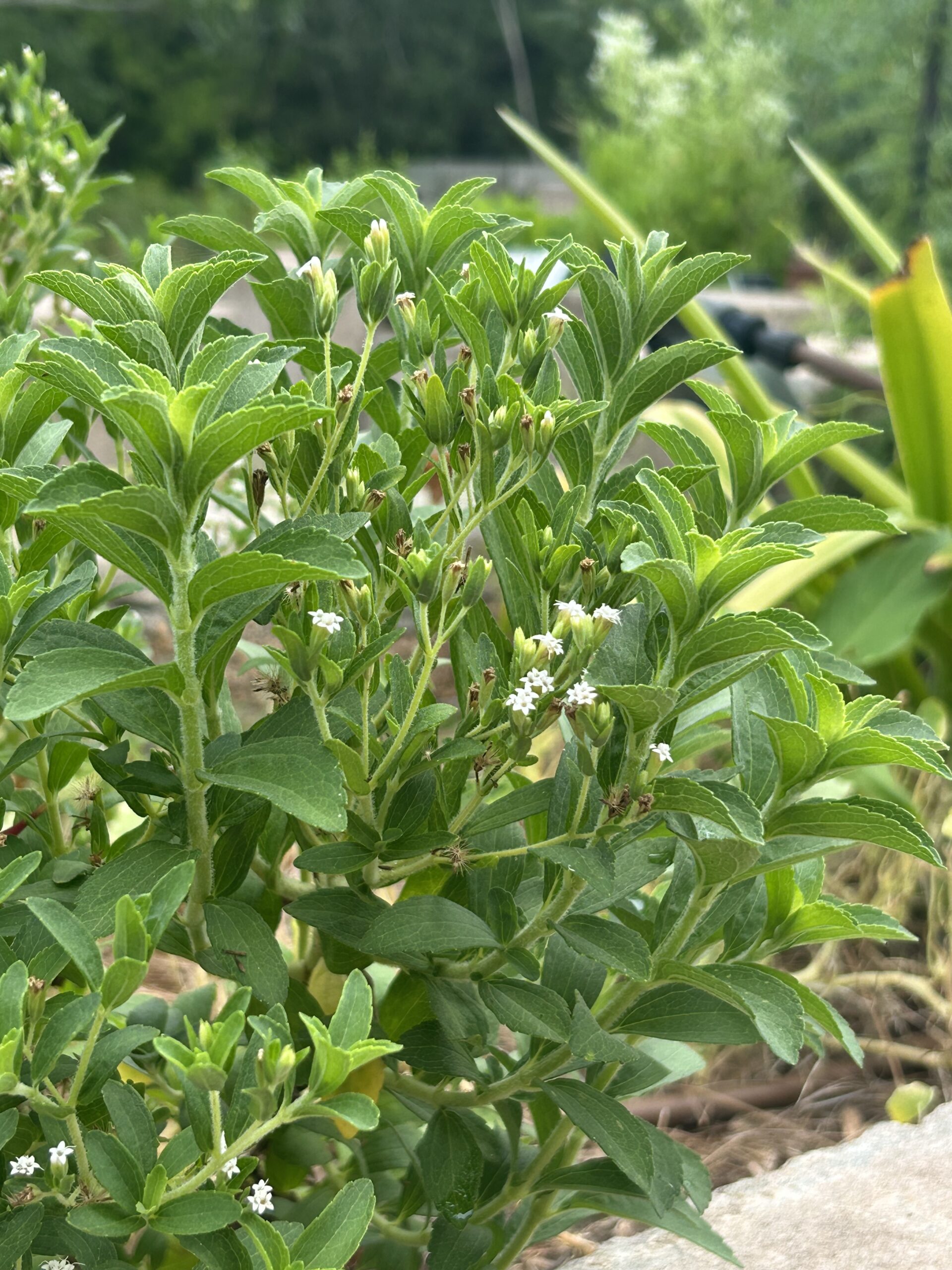
This tender perennial grows 1 to 2 feet tall and wide. It tends to have weak stems, and the leaves are oval to elliptical and up to 1-inch long. The small white flowers appear in clusters of 2 to 6 from July to August.
Growing Conditions :
Stevia prefers full sun to partial shade and requires moist, well-drained, slightly acidic, organically rich soils. It is winter hardy in USDA Hardiness Zones 10 to 11, and thrives in moderate temperatures and humid environments. Fertilize the plants about every 4 to 6 weeks during the growing season. Stevia can be grown as an annual or overwintered indoors. The best time to harvest is just as it begins to flower and pruning the flower buds can help improve the flavor of the leaves. Monitor for aphids and spider mites. Overwatering can cause root rot, and plants overwintered indoors are particularly susceptible.
Propagation :
Stevia can be propagated by stem cuttings or seeds. Stevia seeds are small and germinate slowly, with germination rates often lower than 50%. Stevia is self sterile and must be pollinated to produce viable seeds. Plants produce black and tan seeds. Open pollination results in 0-60% black seeds and controlled cross-pollination results in 86% black seeds, the rest being tan colored. The tan seeds have no germination, but black seeds have 59-86% germination. Propagation of stevia can also be done with stem cuttings, using 4 internodes per cutting for best results.
Folklore & Traditional Uses:
The genus name, Stevia, is in honor of the Spanish botanist and physician, Pedro Jaime Esteve. The specific epithet, rebaudiana, is named in honor of Oviodio Rebaudi, the chemist from Paraguay who first extracted the sweet compounds from this plant.
The indigenous Guaraní people were using its leaves as a medicinal herb to regulate blood sugar prior to European contact. The Guaraní didn’t domesticate the plant or use it as a sweetener as they rarely sweetened their foods. In traditional Brazilian medicine, the herb has been used for its tonic, diuretic, hypotensive, and hypoglycemic properties.
The Swiss-Paraguayan botanist Moises Santiago Bertoni was the first European to write about Stevia. In 1901, Bertoni wrote that a few leaves of Stevia were enough to sweeten a large cup of tea. He introduced the plant to Europeans in the late early 20th century. A 1928 article in the Washington Post noted, “Down in Paraguay grows a plant containing some substances unknown to science 200 times sweeter than sugar.”
Bertoni sent specimens to the Paraguayan chemist Oviodio Rebaudi who determined that one of the two sweet compounds was a type of glucose. In 1920, Stevia began to be cultivated in large quantities on plantations in Brazil and Paraguay. In 1931, the French chemists Briedel and Lavieille isolated the glycoside which provides Stevia with its sweet taste and named the compound stevioside. During World War II, Stevia began to be consumed in the United Kingdom due to sugar shortages and rationing.
Modern & Medicinal Uses:
Modern History and Acceptance :
The 1931 isolation of the diterpene glycoside stevioside was followed in the 1970s by scientists in Japan isolating additional sweet compounds from Stevia. The additional glycosides were rebauadiosides A, B, C, D, and E; and dulcoside.
Stevia is widely used in Japan where the food industry has been using it since the mid-1970s as a sugar substitute.
In 1992 the US health food advocate Donna Gates “discovered stevia” through friends at the Chinese embassy in Washington, D.C. and went on to publish “The Stevia Story” and later “The Stevia Cookbook: Cooking with Nature’s Calorie-Free Sweetener.“
In 2016 the Guaraní-Kaiowá from Brazil and the Guaraní Pãi-tavyterã from Paraguay demanded an ABS contract with global corporations such as Coca Cola and Cargill accusing them of using their traditional knowledge associated with the ka’a he’ẽ plant. An access-and-benefit-sharing (ABS) is a mechanism laid out in the 1992 Convention on Biological Diversity (CBD) designed to fight biopiracy and restore fairness and equity in the exchange of genetic resources. I don’t find that an agreement has ever been reached.
China is currently the largest producer of Stevia. Stevia sweeteners have been approved in over 60 countries.
Chemical Constituents :
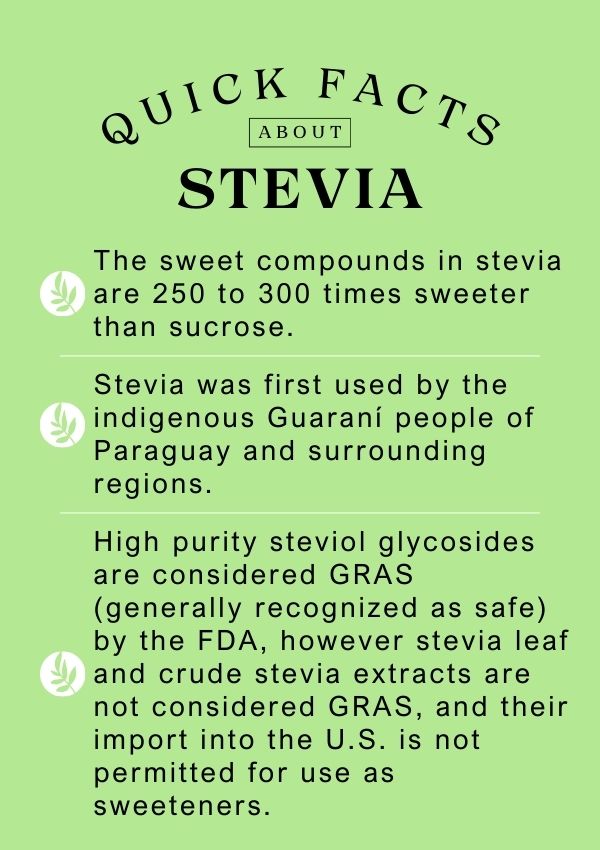
The main sweet compounds in stevia are diterpenoid glycosides known as steviosides and rebaudiosides. Diterpene glycosides are composed of glucose groups attached to carbon rings. These compounds are 250 to 300 times sweeter than sucrose. Rebaudioside A and stevioside are found in the largest amounts, and others, such as rebaudioside D and rebaudioside M are present in smaller amounts. Stevioside has a bitter flavor, but rebaudioside A has a more desirable taste and currently is the most used steviol glycoside in the commercial market.
US Regulatory History :
Since 1995, the FDA has allowed stevia to be imported into the United States only if it is labeled for use in dietary supplements.
In 2007 Coca Cola and the agribusiness giant Cargill announced a joint venture to produce a proprietary stevia extract. In 2008 Coke and Cargill, PepsiCo and Merisant, and Wisdom Natural Brands announced the results of numerous animal studies and human clinical trials on stevia extract which demonstrated its safety. In 2008, the FDA announced that the agency would consider preparations of steviol glycosides made from the herb stevia as generally recognized as safe (GRAS) food substances, however they still do not consider stevia leaf and crude stevia extracts GRAS.
The Coke and Cargill venture resulted in the product Truvia®, Pepsico developed PureVia®, and Wisdom Natural Brands markets SweetLeaf®.
Beginning in 2019, the US company Amyris and Cargill/DSM began marketing Reb A products produced by yeast fermentation using recombinant technology.
Medical Uses :
The primary use of stevia is as a sweetener substitute to prevent the use of sugar. The current FDA guidelines state that stevia leaf and crude stevia leaf extracts are not considered GRAS. However, if the steviol glycosides are extracted and turned into a product, the product is considered GRAS. Chronic studies and clinical studies in humans have been conducted which demonstrate no adverse effects. Some studies have indicated that stevia may have anti‐diabetic, anti‐oxidant, antiviral, and antitumor activity, and may aid in the prevention of high blood pressure and obesity.
Food Uses:
The fresh leaves can be harvested to make tea; however, dried leaves are usually sweeter than fresh leaves. Once the leaves are dried, they are ground to produce stevia powder.
Stevia is commercially available as a liquid, in packets, as a powder, and as a baking blend. Some stevia products sold for home use are diluted with another powder or liquid that allows them to be substituted one-for-one to sugar or to improve the result in baked goods. Common additives and fillers include erythritol, allulose, maltodextrin, dextrose, inulin, xylitol, and glycerin.
References:
Barkley, T. M., Brouillet, L., Strother, J. L., Flora of North America-Asteraceae,
http://www.efloras.org/florataxon.aspx?flora_id=1&taxon_id=10074, Accessed on : 16 July 2025.
Bown, Deni. New Encyclopedia of Herbs & Their Uses. New York: DK Publishing, Inc., 2001.
“Stevia rebaudiana | North Carolina Extension Gardener Plant Toolbox,” Plants.ces.ncsu.edu,
https://plants.ces.ncsu.edu/plants/stevia-rebaudiana/, Accessed on : 16 July 2025.
Gershon, L., “JSTOR Daily-Stevia’s Global Story”, daily.jstor.org, 10 July 2023, https://daily.jstor.org/stevias-global-story/, Accessed on : 16 July 2025.
Marcinek, K., Krejpcio, Z., “Stevia Rebaudiana Bertoni: Health Promoting Properties and Therapeutic Applications.” Journal Für Verbraucherschutz Und Lebensmittelsicherheit, vol. 11, no. 1, 12 July 2015, pp. 3–8, https://doi.org/10.1007/s00003-015-0968-2.
Werner, T., “Cucurbit Breeding-Stevia Breeding”, https://cucurbitbreeding.wordpress.ncsu.edu/, 2025,
https://cucurbitbreeding.wordpress.ncsu.edu/stevia-breeding/, Accessed on : 16 July 2025.
Peteliuk, Victoria, et al. “Natural Sweetener Stevia Rebaudiana: Functionalities, Health Benefits and Potential Risks”. EXCLI Journal, vol. 20, Sept. 2021, pp. 1412-30, https://doi:10.17179/excli2021-4211.
Glenn, L., “ABC Herbalgram Website.” Herbalgram.org, 13 September 2018, https://www.herbalgram.org/resources/herbclip/herbclip-news/2018/stevia/. Accessed 16 July 2025.
Chesterton, B. M., and Yang, T., “The Global Origins of a ‘Paraguayan’ Sweetener: Ka’a He’e and Stevia in the Twentieth Century.” Journal of World History, vol. 27, no. 2, University of Hawai’i Press, 2016, pp. 255–79, https://doi.org/10.2307/43901850.
Relly, Eduardo. “Stevia as a Genetic Resource: Intellectual Property and Guaraní Strategies for Access-and-Benefit Sharing in Paraguay and Brazil.” Environment & Society Portal, Arcadia, no. 13. Rachel Carson Center for Environment and Society. https://doi:10.5282/rcc/9649.
Kinghorn, Douglas, Stevia-The genus Stevia, New York: Taylor and Francis, 2002.
Choudhury, Nandini Roy, “Stevia Market-Global Stevia Market Size, Growth, and Forecast for 2025 to 2035”, http://www.futuremarketinsights.com, 17 June 17 2025, https://www.futuremarketinsights.com/reports/global-stevia-market, Accessed 23 July 2025.
Cavaliere,Courtney, “ABC Herbalgram Website.” Herbalgram.org, 1 December 2009, http://www.herbalgram.org/resources/herbalgram/issues/81/table-of-contents/article3365/. Accessed 23 July 2025.
“Import Alert 45-06.” Fda.gov, 2019, 14 May 2025, https://www.accessdata.fda.gov/cms_ia/importalert_119.html, Accessed 23 July 2025.
Blumenthal, Mark, “ABC Herbalgram Website.” Herbalgram.org, 1 October 2008, https://www.herbalgram.org/resources/herbalgram/issues/80/table-of-contents/article3327/, Accessed 23 July 2025.
Wang, Aoyi, et al. “Structure, Properties, and Biomedical Activity of Natural Sweeteners Steviosides: An Update.” Food Science & Nutrition, vol. 13, no. 2, 1 Feb. 2025, doi:10.1002/fsn3.70002. Accessed 23 July 2025.
“DSM Announces Start of Avansya | DSM.”, our-company.dsm-firmenich.com,1 Mar. 2019, our-company.dsm-firmenich.com/en/our-company/news/press-releases/legacy-archive/2019/05-19-dsm-announces-start-of-avansya.html., Accessed 23 July 2025.
AB, Amyris. “Amyris, AB Mauri Announce Partnership.” WorldBakers,com, 26 June 2020, http://www.worldbakers.com/businesses/amyris-ab-mauri-announce-partnership/. Accessed 23 July 2025.
Adams, Paul. “What Exactly Is Stevia? Ask Paul.” Americastestkitchen.com, Cook’s Illustrated, 16 Aug. 2023, http://www.americastestkitchen.com/articles/7451-what-exactly-is-stevia-ask-paul.
McClees, Heather. “Fillers and Additives: What to Watch out for When Buying Stevia.” onegreen planet,org., 28 July 2014, http://www.onegreenplanet.org/vegan-food/fillers-and-additives-what-to-watch-out-for-when-buying-stevia/. Accessed 23 July 2025.
Return to South America Region
Return to Pharmacy Garden
It is the policy of The Herb Society of America, Inc. not to advise or recommend herbs for medicinal or health use.
This information is intended for educational purposes only and should not be considered as a recommendation or an endorsement of any particular medical or health treatment. Please consult a health care provider before pursuing any herbal treatments.