Butterfly Pea Vine, Blue Pea Vine,
Asian Pigeonwings, Aparajita
Botanical Family : Fabaceae
Native to : Indonesia & Asia
Researched by : Julia Johnson

Botanical Family:
Fabaceae
The Legume Family, which features the characteristic pods of garden peas and beans. Important crops of this family also include soy, lentils, peanuts, alfalfa, and clover. Some tree species include redbud, acacia, rosewood, and locust.
Cultivation:
Native to Indonesia and Asia, but has been introduced to Africa, the Americas, and Australia.
This plant was first described in 1678 by Jakób Breyne, a Polish naturalist, who described it as Flos clitoridis ternatensibus, meaning ‘Ternatean flower of the clitoris’. The specific epithat ternatea refers to the Indonesian island of Ternate where Carl Linneaus first collected this specimen.
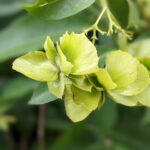
An herbaceous, twining climber with bright green leaves with bright blue flowers that attract pollinators. Some varieties may have white or lilac colored flowers. This tropical perennial grows best in fertile, well-draining soils, and once established they can tolerate lots of heat and dry spells.
Seeds tend to have low germination rates due to a tough seed coat, immersion in boiling water or an acid solution can improve rates. They typically like to germinate in warm (75-80°F), moist soils.
Folklore & Traditional Uses:
In Southeast Asia the flower is used as a natural food coloring especially in glutinous rice dishes and desserts.
Ayurvedic medicine:
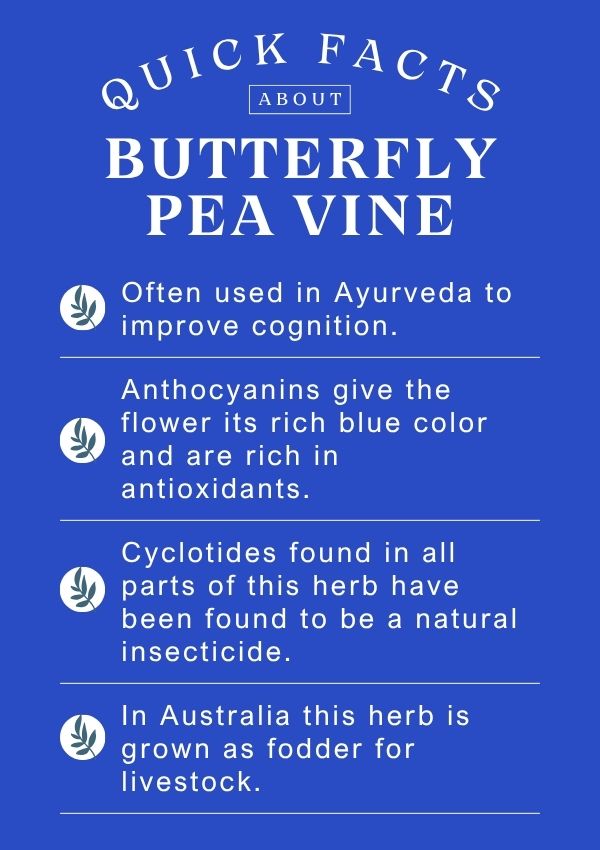
Known as Koyala in Hindi, this herb is associated with enhancing memory, antistress, antidepressant, anticonvulsant, and has sedative properties. Flowers, roots, bark, or seeds can be used depending on the ailment.
It is a “Medhya” herb which refers to herbs that improve learning and memory. It is often used for children with impaired cognition. Blue Pea Vine is also in the “Shirovirechanopaga” group known for detoxing and cleansing the brain. In Ayurveda it is said to improve throat conditions, improve vision, relieve indigestion, strengthen the heart and respiratory system, and is said to aid with neurological disorders, infertility, and acne.

Modern & Medicinal Uses:
Today you may find this herb used in cocktails to perform visual magic when the blue colored alcohol, often gin or absinthe, is mixed with tonic water changing the pH and thus creating a stunning color change from royal blue to almost magenta pink!
Extracts from Blue Pea Flower have a range of pharmacological effects including antimicrobial, anti-inflammatory, analgesic, diuretic, antidiabetic, and insecticidal.
Anthocyanins give this flower its characteristic blue color, while cyclotides (which are present in all tissues of the plant) are potent insecticidal molecules and have been used as an eco-friendly insecticide. In fact, according to the National Library of Medicine this is the only known legume to contain cyclotides.
In Australia this plant has been used as a biorejuvenator near coal mines and a fodder for grazing purposes.
Recipes:
Butterfly Tea (Tisane*)
*Technically this drink is a tisane, or an herbal infusion, only teas made from the plant Camellia sinensis are truly considered “tea.” All teas black, green, white, yellow, pu’er, or oolong come from that plant.
Butterfly Tea is made from infusing the bright blue flowers by pouring boiling water over them for 5-7 min to release their wonderful royal blue color and nutrients. The flowers have little flavor, and are best mixed with other herbs for flavoring. In Thailand and Vietnam this tea/tisane is commonly mixed with lemongrass, honey, and lemon. The acidic lemon juice turns the blue tea to a purple-pink color.
I like to mix mine with mint, honey, and lemon. Or with ginger and honey.
This tisane is full of anti-inflammatory properties which can help reduce pain and inflammation.
References:
Bayton, Dr. Ross and Simon Maughan. RHS Genealogy for Gardeners. London : Quarto, 2017. Print.
Dr. Chauhan, “Aparajita..”, Planet Ayurveda, https://www.planetayurveda.com/library/aparajita-clitoria-ternatea/, Accessed on 6/29/2025.
Oguis, Gilding, Jackson, & Craik, “Butterfly Pea.. a cyclotide-bearing plant…”, National Library of Medicine, https://pmc.ncbi.nlm.nih.gov/articles/PMC6546959/#sec37, Accessed on 6/29/2025.
Return to Southeast Asia
Return to Middle East
Return to Pharmacy Garden
It is the policy of The Herb Society of America, Inc. not to advise or recommend herbs for medicinal or health use.
This information is intended for educational purposes only and should not be considered as a recommendation or an endorsement of any particular medical or health treatment. Please consult a health care provider before pursuing any herbal treatments.